


Remote staffing helps small businesses expand capacity without adding permanent payroll costs. It provides dedicated professionals who own recurring work, follow established systems, and free internal teams to focus on higher-value priorities. It’s most effective as a workforce strategy—not just cheaper labor—by clearly defining roles, hiring the right person, integrating them into daily operations, and tracking performance against business outcomes. This is the approach at Remote Raven.
Key Takeaways
- Remote staffing adds dedicated capacity for recurring work without automatically creating another local, permanent position.
- The strongest use cases are roles with clear responsibilities, repeatable workflows, measurable outputs and manageable decision boundaries.
- The right decision starts with a workload and role analysis, not a generic search for a virtual assistant.
- Total cost should include sourcing, onboarding, tools, supervision, quality assurance, rework, security and the value of capacity released for the core team.
- Successful placements depend on role clarity, structured candidate assessment, documented processes, access controls and deliberate onboarding.
- Remote professionals should be managed through outcomes, service standards and communication routines, not constant online monitoring.
- AI and automation can make remote teams more productive, but they do not remove the need for human judgment, accountability and relationship management.
Why Should Small Businesses Consider Remote Staffing In 2027?
Small businesses should consider remote staffing because growth creates a capacity paradox: more customers increase revenue, but also add inquiries, scheduling, admin, bookkeeping, research, reporting, follow-up, and support. As operations expand, founders and teams spend more time maintaining the business and less time improving the product, serving key accounts, or pursuing new opportunities.
Before creating a new role, owners should identify where time goes and which recurring tasks consume capacity. A founder time audit helps determine what to eliminate, systemize, or delegate.
Hiring is sometimes the right answer—especially when ongoing leadership, sensitive decisions, deep institutional knowledge, or core competitive capabilities are required. But not every gap needs a permanent, on-site employee. Compare the full employment commitment with the full cost of remote staffing using this local-versus-remote hiring cost comparison.
Remote staffing provides a dedicated professional who owns defined functions, works in your systems, follows your processes, and collaborates with your team—adding capacity while you maintain priorities and standards. At Remote Raven, strategic ownership stays in-house while remote professionals handle work that can be done anywhere. By 2027, the shift is from headcount to work design.
What Is Remote Staffing, And How Does It Differ From Outsourcing?
Remote staffing is a workforce model where a business engages a remote professional as a dedicated, ongoing member of the client’s team, supporting functions like admin, customer support, sales support, finance, marketing coordination, or technical support. Unlike outsourcing, the client sets priorities, assigns work, defines processes, and reviews performance, while an outsourcing provider delivers defined services or outcomes under agreed service levels. It also differs from freelancers who complete one-off tasks, because remote staff are embedded in recurring workflows for sustained capacity and continuity.
|
Model |
Who directs daily work? |
Best suited to |
Main consideration |
|
Remote staffing |
The client sets priorities and manages the professional’s work. |
Recurring responsibilities requiring dedicated capacity. |
The client needs role clarity, onboarding, and day-to-day management. |
|
Outsourcing |
The provider manages delivery against agreed service levels. |
A defined service or outcome with provider-led execution. |
The contract must clarify deliverables, service levels, and accountability. |
|
Freelance / project work |
The client defines the brief and reviews the deliverable. |
Finite projects or specialist assignments. |
Continuity and availability may vary after the project ends. |
|
Permanent in-house hiring |
The employer manages the employee within its organization. |
Core roles requiring sustained internal ownership or physical presence. |
The business takes on a longer-term employment commitment. |
Which Business Problems Can Remote Staffing Solve?
Remote staffing solves real capacity or capability gaps that can be addressed through a clearly scoped role. It should not be used as a shortcut for unclear processes or unresolved management problems. Before opening a role, identify the pressure the business is trying to remove. This role-first assessment is how we begin every engagement at Remote Raven.
How Can Remote Staffing Reduce Founder Bottlenecks?
Founders often hold onto tasks they’re simply good at—calendar and inbox management, CRM updates, meeting prep, routine research, document organization, and follow-up—when that time should go to strategy, sales, partnerships, and leadership. A remote assistant can own this work once processes and decision boundaries are clear.
If routine decisions and approvals keep bouncing back to the founder, the issue is likely structural, not time-related—explored in why your business still runs on you. Delegation works best when the founder chooses what to transfer, documents the expected outcome, and gives the new owner space to execute. A repeatable four-step handover framework helps formalize the process.
Remote support staff can also improve response and follow-up by handling routine inquiries, record updates, appointment coordination, and escalations within defined targets, triggers, and approved language. Similarly, they can support pipeline development through prospect research, list building, CRM hygiene, and follow-up coordination, covered in strategies for effective lead generation with virtual assistants.
How Can Remote Staffing Free Time For Revenue-generating Work?
Sales teams lose time to data entry, consultants waste billable hours on scheduling and document formatting, and managers manually build reports instead of using them. Remote staffing shifts repeatable operational tasks to a dedicated professional, freeing productive time across the business. The financial case should factor in both completed work and recovered capacity, not just fees—see our return on investment of remote outsourcing.
How Can Remote Staffing Provide Skills A Business Cannot Hire Full-time?
A small business may need bookkeeping, campaign operations, lead research, technical support or specialist administrative skills without enough work to justify a full-time local position. Remote staffing widens the available talent pool and makes it possible to secure recurring support that matches the workload. For senior or intermittent needs, a fractional specialist may be more appropriate; see our comparison of fractional and full-time bookkeepers.
The same role-design principle applies across professional services. Law firms can delegate defined administrative and document workflows, while real estate teams can transfer listing coordination and lead follow-up. Explore these use cases through our virtual assistant services.
How Can Remote Staffing Help When Demand Grows Faster Than The Team?
A business experiencing a sustained increase in transactions, customers or service requests may need more capacity before it is ready to build a larger permanent team. A remote professional can help the business meet that demand while leadership tests whether the workload is stable, seasonal, or likely to expand. The arrangement should still be reviewed regularly; flexibility is valuable only when the business actively manages it.
Which Roles Are Best Suited To Remote Staffing?
The best remote staffing roles depend on the work itself, not on trendy titles. A role is a strong fit when tasks can be performed through digital systems, outputs are measurable, processes are documented and exceptions can be escalated efficiently. At Remote Raven, this framework helps identify roles that can be delegated without compromising quality or accountability.
Common remote staffing roles include:
- Administrative and Executive Support: calendar and inbox management, meeting preparation and follow-up, with clarity on what the professional can decide independently.
- Customer Service and Customer Success: first-line inquiries with defined escalation paths and data access.
- Sales and Lead Generation Support: prospect research, CRM updates, and lead qualification.
- Finance and bookkeeping support: transaction categorization and reconciliations with proper approvals.
- Marketing and Creative Operations: content scheduling and campaign coordination, with clear internal ownership of final approvals.
- IT and User Support: help desk triage and account administration.
- Industry-specific Administration: for example, healthcare practices can delegate scheduling, patient communication and records coordination within regulatory boundaries, while clinicians keep clinical decisions.
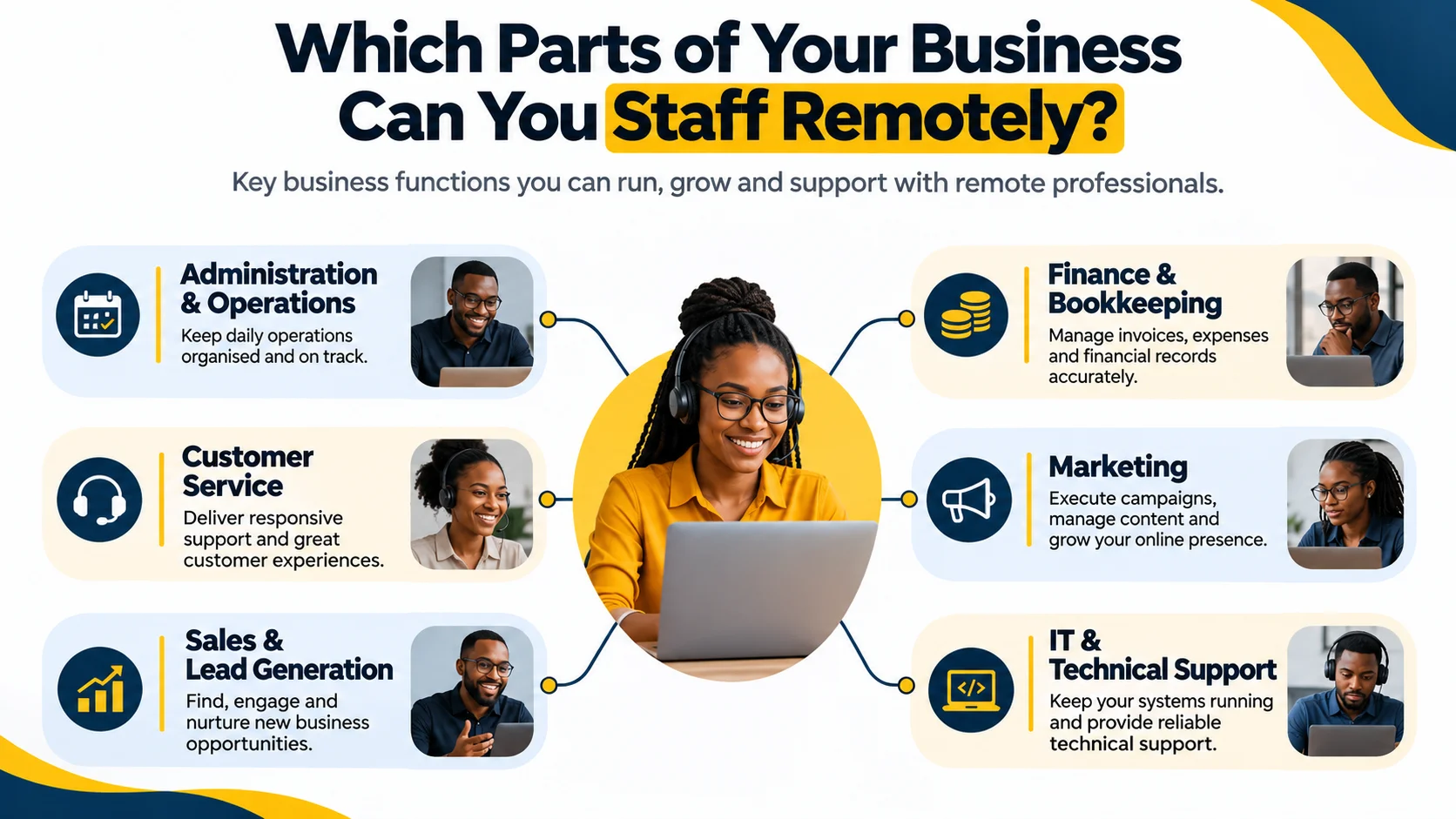
A job title alone is not enough to define a remote role. “Virtual assistant” can mean anything from inbox management to complex operations coordination. Businesses should specify the recurring tasks, systems, expected outputs, working hours, communication requirements, and decision limits before assessing candidates.
|
Business function |
Examples of remote responsibilities |
What should remain owned internally? |
|
Administration / executive support |
Calendar and inbox coordination, meeting preparation, travel research, document organization and follow-up. |
Strategic priorities, sensitive approvals, and decisions reserved for leadership. |
|
Customer service |
First-line inquiries, ticket management, customer updates, appointment coordination, and routine issue resolution. |
Policy exceptions, refunds or commitments outside agreed authority, and sensitive escalations. |
|
Sales support |
Prospect research, CRM updates, lead qualification against agreed criteria and follow-up coordination. |
Sales strategy, pricing, negotiation, and closing key accounts. |
|
Finance support |
Invoice preparation, transaction categorization, records collection, and reconciliation support. |
Payment approvals, financial controls, statutory sign-off and final financial decisions. |
|
Marketing operations |
Content scheduling, campaign coordination, research, reporting preparation and asset organization. |
Brand positioning, campaign strategy, and final approvals. |
|
IT / technical support |
Help desk triage, user support, account administration, and routine technical tasks. |
Security policy, high-risk access approvals, and architecture decisions. |
The quality of the role definition directly affects the quality of the shortlist. When assessing candidates, look beyond general claims of being organized or adaptable and evaluate the specific capabilities the work requires. Our guide to what to look for when hiring remote talent sets out the qualities and evidence that matter.
How Can You Tell Whether A Role Is Suitable For Remote Staffing?
A role is suitable for remote staffing when the work is recurring, measurable, accessible online and supported by someone who can manage it. The decision should be based on the work, the level of collaboration required, the risk involved, and the business’s ability to manage the role effectively.
|
Decision question |
Remote staffing is a stronger fit when… |
Consider another model when… |
|
Is the work recurring? |
The business has an ongoing workload and needs consistent ownership. |
The work is a one-off deliverable with a clear end date. |
|
Can success be measured? |
Outputs, quality, and turnaround can be described clearly. |
The work is exploratory, or success cannot yet be defined. |
|
Can it be performed remotely? |
Systems, data and collaboration can be accessed securely online. |
Physical presence, local licensing, or on-site interaction is essential. |
|
Is management available? |
A process owner can set priorities, give feedback, and resolve exceptions. |
No one can provide direction, context, or timely decisions. |
|
Is the risk manageable? |
Permissions, confidentiality, and escalation controls can be established. |
The role requires unrestricted access or carries unmanageable regulatory exposure. |
Choose the right approach based on role fit: use in-house hires for strategic, confidential work needing frequent in-person collaboration; project specialists for fixed, end-dated deliverables; and automation for stable, rules-based, high-volume tasks. Remote staffing works best for ongoing responsibility that still requires communication, judgment, follow-through, and exception handling—the framework we use at Remote Raven.
How Do You Calculate The True Cost And Value Of Remote Staffing?
The true cost of remote staffing is the total cost of producing work to the required standard, not the hourly rate alone. A lower rate does not automatically produce a lower operating cost, and a higher rate does not automatically mean better value.
What Costs Should You Include When Comparing Remote Staffing?
A useful comparison includes the professional’s compensation or service fee, recruitment and placement costs, onboarding time, software and equipment, supervision, quality assurance, training, coverage arrangements, rework and the cost of errors. It should also account for the internal time released when work is transferred successfully.
|
Cost area |
What to include |
Why it matters |
|
Sourcing and placement |
Recruitment effort, screening, selection and any placement fee. |
Shows the cost of finding and securing suitable talent. |
|
Professional / service cost |
Hourly rate, monthly fee, agreed hours and coverage requirements. |
Establishes the direct cost of the capacity. |
|
Onboarding and training |
Manager time, process documentation, tool training, and supervised work. |
Captures the investment needed before consistent delivery. |
|
Systems and equipment |
Software licenses, devices, connectivity, and secure access. |
Ensures the professional can work within the business environment. |
|
Management and quality |
Supervision, reviews, quality checks, rework, and escalation handling. |
Reveals the ongoing cost of maintaining standards. |
|
Business value |
Capacity released, turnaround improvement, reduced backlog, and accepted output. |
Connects spending on operational and commercial outcomes. |
Define a meaningful unit of output for each role—such as a resolved customer inquiry, processed invoice, qualified lead, scheduled appointment, updated CRM record, or completed report—and compare the total cost of producing accepted outputs, not just hours purchased.
For instance, if you hire remote admin support for 80 hours per month, weigh the monthly cost against the volume and quality delivered, the management time required, and the internal capacity freed up. Any rate advantage can vanish if instructions are unclear or work needs frequent correction; consistent, accurate work can unlock capacity without adding fixed headcount.
At Remote Raven, pricing reduces upfront commitment: no start-up fees, payment starts after placement, and rates begin at $10/hour, with final cost based on role, experience, hours, and requirements.
How Should You Measure The Value Of Capacity Released?
The value of remote staffing may appear as faster customer response, reduced backlog, more consistent administration, improved sales follow-up, more billable time, fewer missed appointments or less founder involvement in routine tasks. These benefits should be translated into measures wherever possible. At Remote Raven, we focus on outcomes our clients can see and track.
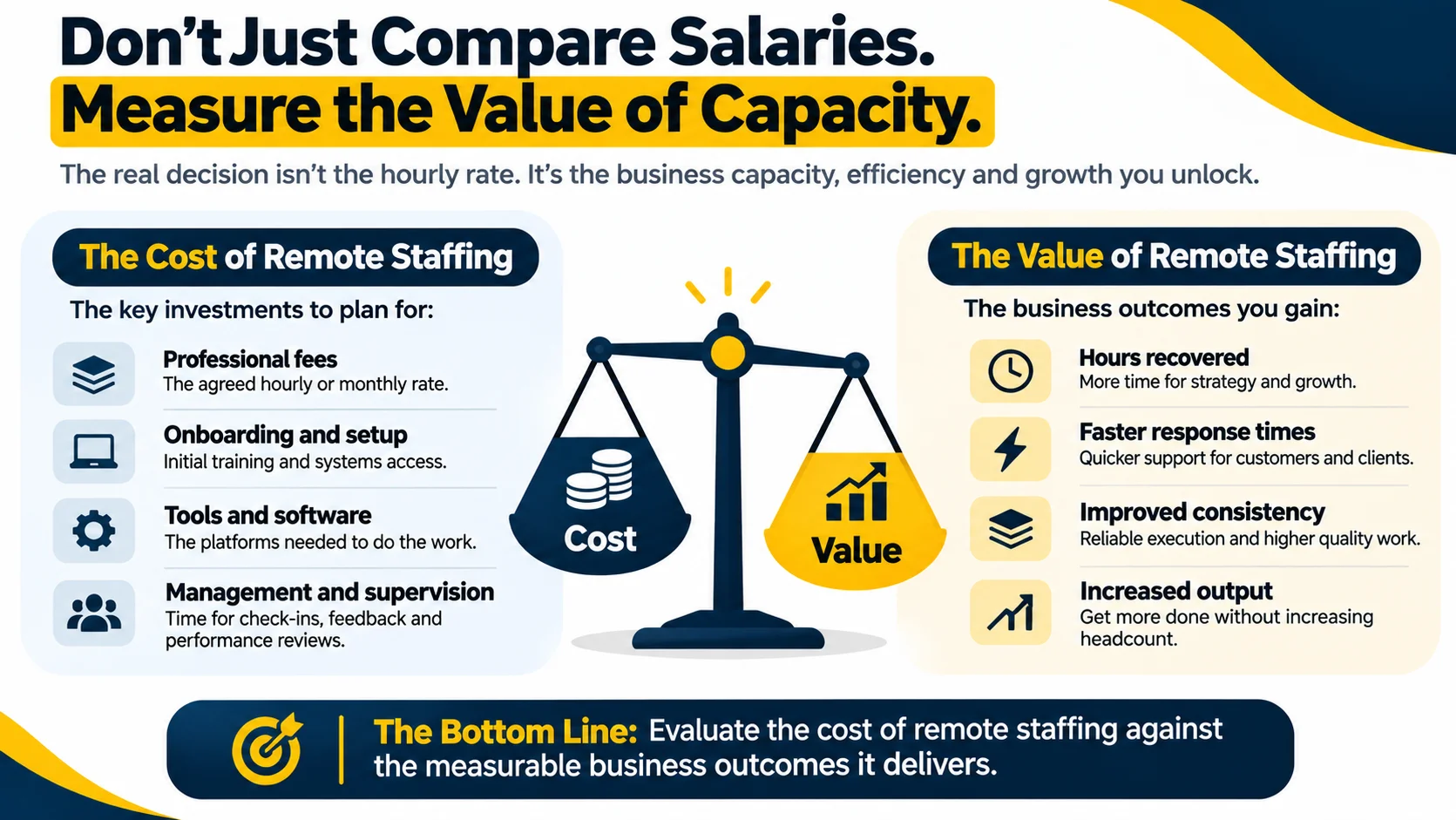
A simple before-and-after baseline helps. Record the current backlog, turnaround time, error rate, response time, number of completed outputs and hours spent by internal staff. After onboarding, review the same measures at agreed intervals. The purpose is to understand whether the role is improving the operation, not to claim savings based on assumptions.
How Do You Hire The Right Remote Professional?
Hire the right remote professional by defining the role first, evaluating candidates through real work, and agreeing clear success measures before they start. Choose based on the role needs—not a polished résumé or the lowest rate—an approach we follow at Remote Raven.
Selecting a provider is also part of risk management: know how candidates are screened, what post-placement support is included, how security is handled, and what total cost covers, as explained in our guide to choosing a virtual staffing company.
For the full end-to-end process—from business problem and role design to sourcing, validation, selection, secure setup, integration, and measurement—see how remote staffing works, from job description to first day.
How Do You Define The Business Need And Role Outcomes?
Begin with the work that needs to be completed. Document the recurring responsibilities, expected outputs, tools, working hours, communication requirements, performance standards and escalation points. Separate essential requirements from skills that can be taught after hiring. This prevents the role from becoming an unrealistic list of every task the business would like someone to handle.
How Should You Assess Candidates Against Real Work?
Use structured interviews and job-like practical assessments (e.g., support scenarios, calendar/inbox exercises, or discrepancy investigations). Keep assessments proportionate, ethical, and relevant, and don’t request unpaid work you’ll use. Evaluate communication, reliability, problem-solving, detail, tool skills, and process adherence, including handling ambiguity, priorities, and escalations.
How Do You Validate Role Fit And Working Conditions?
Confirm availability, time-zone overlap, working hours, connectivity, equipment, language requirements and experience with the relevant systems. Discuss confidentiality, data handling, supervision and expectations for reporting progress. A candidate can be capable and still be a poor fit if the working arrangement does not support the business’s operating needs.
How Should You Agree On Responsibilities And Success Measures?
Before the start date, align on role scope, reporting, communication channels, quality standards, response times, decision rights, and review cadence. Clarify what the professional owns, what the manager approves, and what must be escalated—especially for customer, financial, sensitive data, or external commitments.
A structured approach, like our hiring process, reduces gut-driven decisions by guiding the business from role definition through assessment, selection, and a clear start plan.
How Do You Onboard Remote Staff For Productivity?
Onboard remote staff with a role-specific plan, careful system access, and clear 30/60/90-day milestones. Hiring isn’t the finish line: early weeks determine whether a remote professional understands the business, has the right access, knows how work flows, and can make good decisions—poor onboarding can make strong hires look ineffective.
Create an onboarding plan covering the business, customers, products, values, tools, workflows, and key contacts. Clarify the “why” of the role and provide documented procedures, quality examples, templates, escalation rules, and a check-in cadence.
Provision access deliberately: grant only what’s needed, use MFA, avoid shared passwords, define access changes/revocation, and protect sensitive data to meet legal/contract obligations. Use 30/60/90-day milestones—supported by a complete remote employee onboarding plan—to build from accuracy to ownership and assess outcomes by month three.
How Do You Manage Remote Professionals Without Micromanaging?
Manage remote professionals without micromanaging by setting clear expectations, reliable communication routines, and outcome-based measures. Remote work increases the need for clarity, so leaders should adjust how they build trust, communicate, give feedback, and maintain connection, as outlined in our guide to managing remote employees.
Define role-specific performance metrics: customer support (response time, resolution quality, customer satisfaction, escalation accuracy), sales support (CRM completeness, lead research accuracy, follow-up completion), and administrative roles (turnaround time, error rates, backlog, reliability). Focus on outcomes the professional can control; our measuring remote performance without micromanaging guide explains more.
Avoid using green dots, screenshots, or constant availability as performance proxies. Use one-to-ones, workload reviews, quality sampling, documented feedback, balanced scorecards, and clear escalation paths.
How Should AI And Automation Support A Remote Staffing Strategy?
AI and automation should take on stable, routine tasks, while remote professionals handle coordination, judgment, and exceptions. Used well, they reduce repetitive work in drafting routine messages, summarizing information, classifying requests, preparing reports, extracting data, and triggering workflow steps.
Automation and remote staffing work best together. For example, automate appointment reminders, have a remote professional manage scheduling exceptions, and keep an internal manager for sensitive decisions. In finance operations, software can capture transactions, a remote bookkeeper can manage records and reconciliations, and an internal approver can sign off on payments and statements.
AI can also assist remote professionals with drafting, summarizing, and routine analysis (see how AI makes human virtual assistants more powerful), with humans ensuring accuracy and context. Automate clear, stable tasks, but assign human ownership for review and exceptions. Before adopting AI, evaluate data quality, privacy, accuracy, integration, maintenance, and error impact. The goal is a balanced team—technology for routine work, people for context, trust, judgment, and accountability.
What Systems And Controls Does A Remote Team Need?
A remote team needs a shared operating environment with reliable systems, documented processes, and controlled access. That does not mean an expensive technology stack; it means the essentials must be dependable enough for work to move without confusion. We emphasize this operational foundation at Remote Raven.
- A central task or project system that shows ownership, priority, deadlines, and status.
- A documented source of truth for procedures, templates, policies and recurring instructions.
- Approved communication channels for daily coordination, meetings, and urgent escalations.
- Role-based access to email, customer systems, finance tools, files, and other business applications.
- A password manager and multi-factor authentication to reduce account security risks.
- A process for quality checks, approvals, incident reporting and access removal when responsibilities change.
Business systems should reflect how the company truly operates, so remote professionals aren’t forced to piece together instructions from chats or guess which spreadsheet is current. Clear ownership and documented workflows reduce reliance on individual memory and improve resilience as the team grows. Tools alone aren’t an operating model; the business must unify people, processes, automation, and accountability—see the business systems stack.
What Are The Most Common Remote Staffing Mistakes, And How Can You Avoid Them?
- Hiring before defining the work: A vague role attracts mismatched candidates and creates confusion after placement. Document the workload, outputs, tools, and decision limits first.
- Treating remote staffing as a cheap-labor strategy: A low rate cannot compensate for weak capability, poor communication or rework. Compare total delivery cost and accepted output.
- Transferring tasks without context: A task list without examples, priorities and escalation rules leaves the professional guessing. Provide procedures and explain why the work matters.
- Expecting a new hire to fix broken processes: A remote professional cannot independently resolve duplicated approvals, inconsistent data or unclear ownership. Simplify the workflow before or during onboarding.
- Keeping every decision with the founder: If routine work still waits for founder approval, the business has transferred tasks but not responsibility. Define decision rights and escalation thresholds.
- Measuring activity instead of outcomes: Hours online and messages sent do not prove value. Measure accuracy, turnaround, quality, customer impact and reliable completion.
- Ignoring security and compliance: Remote access expands the number of people and devices interacting with business information. Apply least privilege, MFA, approved tools and documented offboarding.
- Failing to review the arrangement: Workloads change. Review role scope, performance, hours and cost regularly, so the model continues to fit the business.
How Can You Introduce Remote Staffing In 90 Days?
A staged 90-day implementation gives a small business time to validate the role, integrate the professional and correct problems before expanding the model.
|
Period |
Primary focus |
Key actions |
Evidence of progress |
|
Days 1–15 |
Diagnose the capacity gap |
Audit recurring work, identify bottlenecks, establish workload and performance baselines. |
A prioritized list of tasks and a defined business case. |
|
Days 16–30 |
Define and select |
Write the role scope, set requirements, assess candidates, and confirm expectations. |
An agreed role profile and a selected candidate. |
|
Days 31–45 |
Onboard and transfer work |
Provide secure access, document workflows, and transfer tasks in stages. |
The professional completes supervised work accurately. |
|
Days 46–60 |
Build consistent delivery |
Increase ownership, review quality, and resolve process gaps. |
Reliable delivery against agreed standards. |
|
Days 61–90 |
Evaluate business impact |
Compare results with the baseline, assess cost and capacity released, and refine the arrangement. |
A decision to retain, refine or expand the role. |
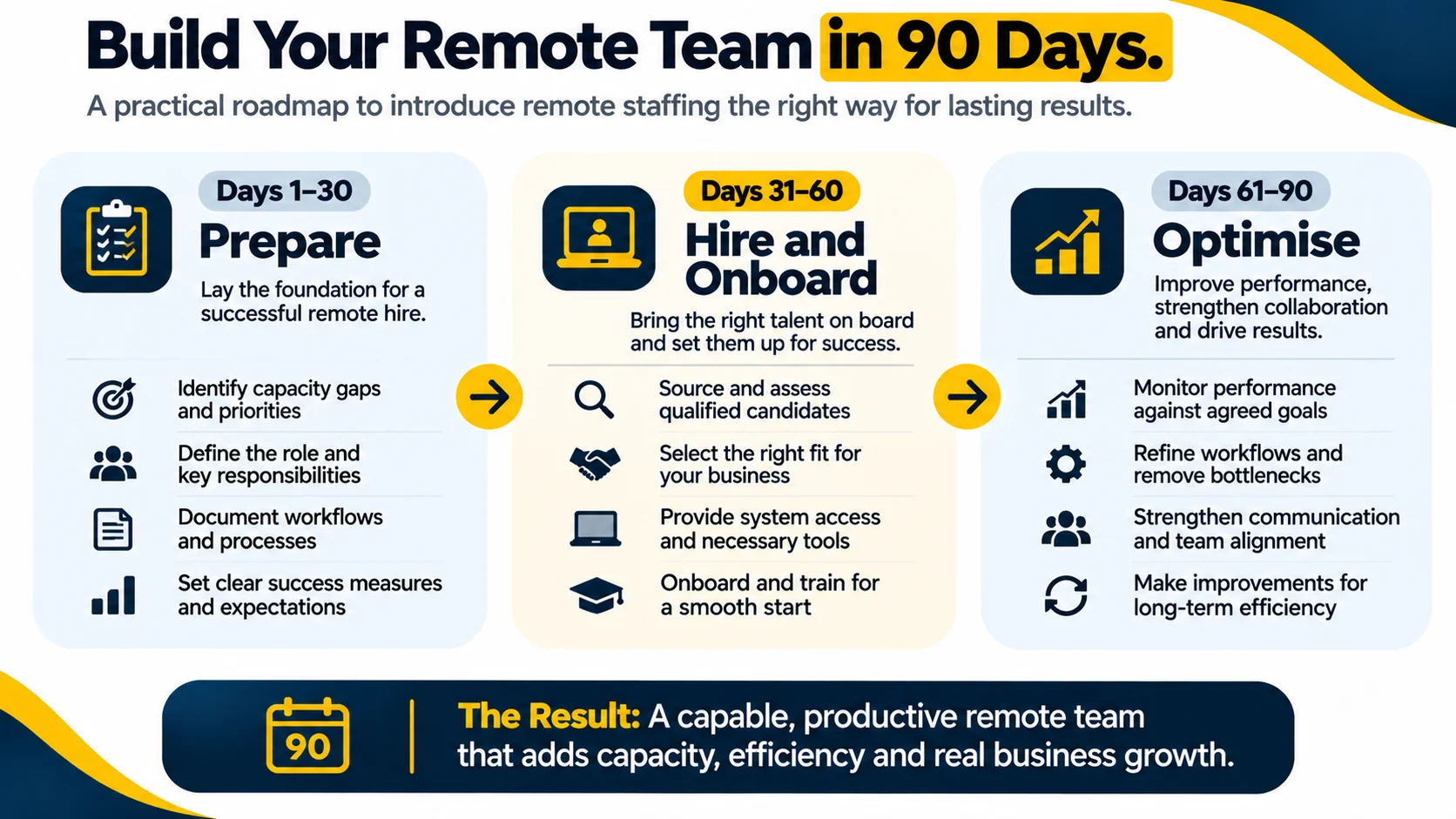
Image 3 – 90-Day Roadmap: A practical 90-day plan to hire, onboard and optimise your remote team.
When Should A Business Choose Permanent Hiring Instead Of Remote Staffing?
Choose permanent hiring when you need ongoing on-site presence, sensitive internal authority, close daily collaboration that can’t be done remotely, or a long-term capability you want to build and keep in-house. Remote Raven advises clients when a role should be filled internally.
Also factor in legal and regulatory constraints, information sensitivity, local employment obligations, contracts, and the true working relationship. Because worker-classification rules vary by jurisdiction, get legal and tax advice—don’t assume remote work equals independent contracting.
A strong workforce strategy matches each responsibility to the right model (employees, remote professionals, specialist providers, contractors, or automation) and is reviewed over time. For help weighing staffing partners vs. direct contractors, see our guide to choosing a virtual staffing company.
How Can Remote Raven Help Your Business Build A Remote Team?
Remote Raven is a virtual staffing company based in Scottsdale, Arizona, that places dedicated, full-time remote professionals with U.S. businesses. Our approach begins with understanding the role, the work that needs to be done, and the conditions required for a successful placement. We then support candidate sourcing and screening, client selection and onboarding, so the professional becomes part of the business’s operating rhythm.
Why businesses choose Remote Raven:
- Industry experience: placements across healthcare, legal, construction, finance and accounting, real estate, digital marketing and general business roles, plus fractional bookkeeping.
- Global talent: professionals based mainly in the Philippines, Latin America and Africa.
- Security and compliance: SOC 2 Type II compliant, with Ravens working on HIPAA-compliant platforms and ongoing cybersecurity awareness training.
- Insurance coverage: International Cyber/Privacy Liability, Errors & Omissions (Professional Liability) and Crime insurance.
- Speed: a typical search reaches candidate introduction in about 15 business days, depending on the job description and skills required.
- Low upfront commitment: no start-up fees, payment begins after a successful placement, and rates start from $10 per hour. Final pricing is tailored to the role.
Remote staffing works best as a partnership between a business that understands its operating needs and a professional who has the skills and support to deliver. The business remains responsible for setting priorities, providing context and managing outcomes. The professional brings capability, consistency and additional capacity.
Ready to scale without expanding permanent payroll? Schedule a consultation with Remote Raven to scope your first remote role.
What Should Small Businesses Prioritize When Building A Workforce For 2027?
Small businesses should scale sustainably in 2027 by focusing on work design—not headcount. Top companies will understand their work, protect differentiators, and build flexible capacity, as Remote Raven supports. Remote staffing can add dedicated professionals to recurring workflows, improving execution and relieving teams. Success requires clear roles, careful hiring, secure systems, strong onboarding, and performance management. The goal isn’t replacing permanent hires, but basing workforce choices on real work needs, not payroll assumptions.
Frequently Asked Questions
What is remote staffing for small businesses?
Remote staffing for small businesses is a model in which a business engages a dedicated professional who works remotely but contributes to ongoing operations. The professional may handle administration, customer service, sales support, finance operations, marketing coordination, or other defined responsibilities within the company’s systems and workflows.
How can remote staffing help a business scale without hiring more employees?
Remote staffing provides dedicated capacity for recurring work without automatically creating another local, permanent position. It helps a business manage growing workloads, improve follow-up and free internal employees to focus on strategic, customer-facing, or specialist responsibilities.
Which roles can a small business staff remotely?
Common roles include administrative assistants, executive assistants, customer support professionals, sales support specialists, lead researchers, bookkeeping support, marketing coordinators, and technical support professionals. Suitability depends on the tasks, required expertise, data access, and whether the role can be performed without physical presence.
Is remote staffing cheaper than hiring a full-time employee?
Remote staffing offers a different cost structure, but it is not automatically cheaper in every situation. Compare the full cost of recruitment, compensation or service fees, tools, onboarding, supervision, quality assurance, coverage, security and rework. The right measure is cost per accepted output and the business capacity gained.
What is the difference between remote staffing and outsourcing?
Remote staffing provides a dedicated professional who works within the client’s priorities and workflows. Outsourcing involves purchasing a defined service or outcome from a provider. The distinction depends on who directs the work, manages delivery and owns quality, which is why responsibility for day-to-day direction should be clear in any agreement.
How do you manage remote staff effectively?
Set clear responsibilities, outputs, working hours, communication routines, decision rights and escalation rules. Provide documented processes and regular feedback. Measure quality, turnaround, accuracy and business impact rather than relying on online status or constant monitoring.
How long does it take to onboard a remote professional?
Onboarding time depends on role complexity, systems access and the quality of existing documentation. A structured 30-60-90-day plan moves from orientation and supervised tasks to increasing ownership and a formal review of performance and business impact.
How long does it take to find a remote professional through Remote Raven?
A typical Remote Raven search reaches candidate introduction in about 15 business days, depending on the job description and the skills required.
How much does remote staffing cost?
Costs vary by role, experience, hours and requirements. At Remote Raven, pricing starts from $10 per hour, there are no start-up fees, and payment begins after a successful placement. The final cost should be assessed alongside onboarding, tools, supervision and the value of the work delivered.