

Key Takeaways
- Remote hiring should evaluate working behavior, not just background. A résumé can’t prove how someone communicates, prioritizes, and delivers in a distributed environment.
- Autonomy changes what “good” looks like. The best remote employees pair role capability with self-management, accountability, and reliable follow-through.
- Evidence beats impressions. Skills-based hiring (work samples, simulations, structured interviews) reduces guesswork and makes remote staffing decisions more defensible.
- Communication is operational, not cosmetic. In distributed teams, clarity, documentation, and timely escalation directly affect speed and quality.
- Remote Raven hires for outcomes. We look for people who can deliver measurable results through strong habits, not people who simply “interview well.”
What should you look for when hiring remote talent?
When hiring remote talent, evaluate more than technical skills or previous experience. Remote work changes how capability needs to be assessed because leaders see fewer informal signals day-to-day. Look for evidence of role-specific capability plus remote-work behaviors: clear communication, reliability, self-management, accountability, problem-solving, digital fluency, adaptability, team fit, and the ability to work independently and ask for help appropriately.
Remote hiring is not office hiring “from home”
Remote hiring is not office hiring with a video call added. In an office, weak systems can be patched by proximity: a manager can walk over, clarify priorities, or notice confusion. In distributed teams, work moves through written updates, tools, and handoffs—so gaps in communication, ownership, and prioritization show up as missed deadlines and management overhead.
At Remote Raven, our philosophy is simple: an impressive CV may open the conversation, but it should not close the decision. The better question is not “Does this person look qualified?” but “Can this person reliably produce outcomes in the way this role actually operates?” That’s why Remote Raven evaluates how someone works (habits, judgment, ownership) alongside what they can do (skills and role capability).
This matters because remote and hybrid work are now a durable operating model, not a temporary perk. Gallup reported in May 2026 that among remote-capable employees, 52% worked hybrid and 26% worked exclusively remote—making disciplined remote hiring and remote workforce management a core leadership competency. (Gallup, 2026: https://www.gallup.com/401384/indicator-hybrid-work.aspx)
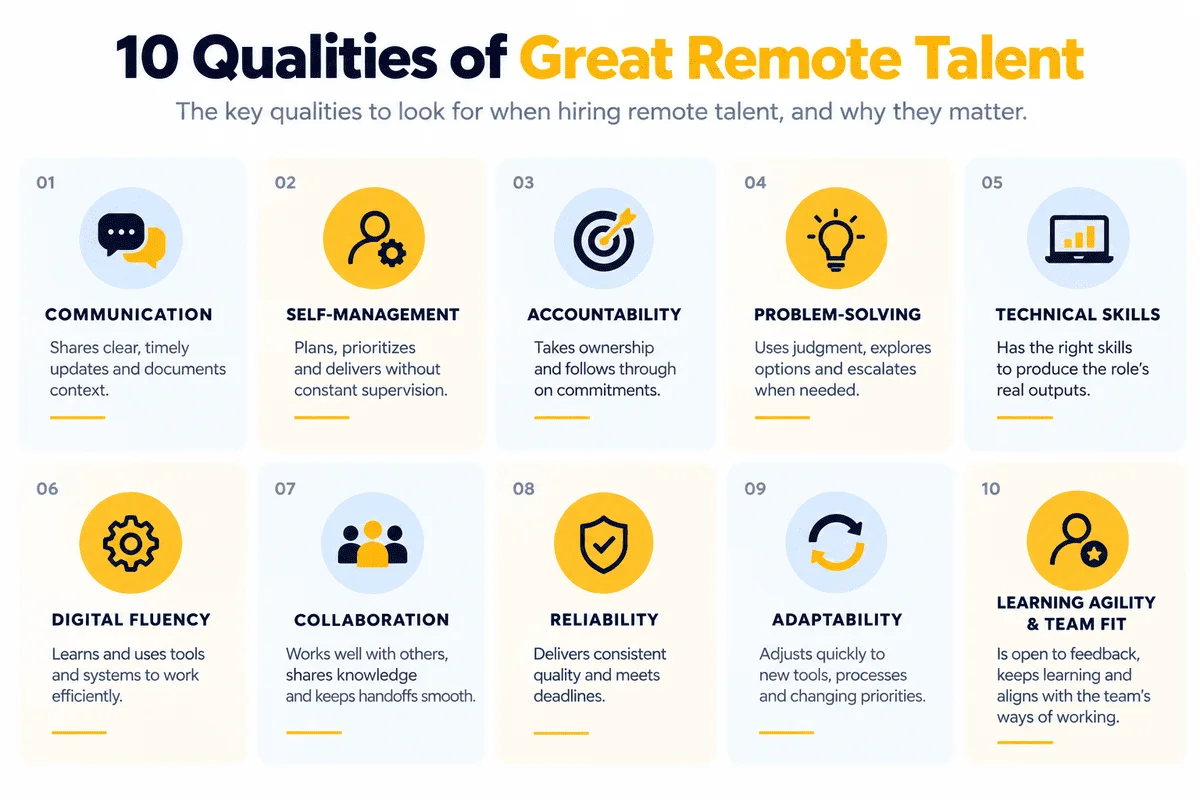
10 Qualities at a Glance (Remote Raven’s Evaluation Lens)
|
Quality |
Why It Matters in Remote Work |
How to Assess It |
|
Communication |
Work depends on clarity, context, and documentation—not hallway conversations. |
Written update exercise + structured interview scenarios |
|
Self-management |
Autonomy only helps if priorities, time, and focus are actively managed. |
Prioritization task + weekly planning walkthrough |
|
Accountability |
Managers can’t manage “presence”; they need ownership and transparent progress. |
Behavioral interview on owned outcomes + references on follow-through |
|
Problem-solving |
Remote teams can’t escalate every ambiguity; good judgment protects speed. |
Role scenario with trade-offs + escalation thresholds |
|
Technical skills |
Titles don’t equal ability; capability must match the role’s real outputs. |
Work sample, simulation, portfolio walkthrough |
|
Digital fluency |
Distributed execution runs through tools, systems, and traceable workflows. |
Tool-learning story + lightweight practical task |
|
Collaboration |
Remote doesn’t mean disconnected; handoffs and knowledge-sharing drive results. |
Cross-functional project story + panel interview |
|
Reliability |
Consistency reduces coordination cost and stabilizes remote onboarding. |
Process adherence in hiring + references on consistency under pressure |
|
Adaptability |
Tools, processes, and priorities change faster in distributed environments. |
Change narrative + learning proof + response to feedback |
|
Learning agility & team fit |
Fit is alignment with ways of working and values—not personality similarity. |
Values scenarios + working-style alignment check |
1) Why is Communication Important when Hiring Remote Employees?
Communication is critical in remote hiring because it determines speed, accuracy, and trust when people aren’t co-located. Strong remote talent shares context, documents decisions, communicates risks early, and chooses the right channel—reducing delays and rework.
Distributed teams run on written clarity. When updates are vague or late, managers spend time chasing information; dependencies slip, and small misunderstandings become expensive problems.
In a remote environment, communication is part of the employee’s output—not simply a soft skill. If communication is weak, the business effectively pays a “translation tax” in meetings and follow-ups.
Assess it with a short-written exercise (for example, “Write a project update for a stakeholder”), ask the candidate to summarize a complex situation in 60 seconds, and run consistent scenarios across finalists (missed deadline, ambiguous request, conflicting feedback).
Structured interviews based on job competencies can show strong validity and reliability when administered consistently. (U.S. Office of Personnel Management, guidance: https://www.opm.gov/policy-data-oversight/assessment-and-selection/other-assessment-methods/structured-interviews/)
2) Can the Candidate Manage their Work without Constant Supervision?
A strong remote hire can plan, prioritize, and execute without being micromanaged. Self-management matters because remote employees have more autonomy, fewer interruptions, and fewer “in-the-moment” corrections.
In remote employee management, work is rarely “kept on track” by proximity. If a person can’t manage time, priorities, and blockers, the team loses momentum and leaders end up doing unnecessary workforce management.
Remote work requires autonomy, but autonomy without accountability is not a hiring advantage. Strong candidates can describe systems (planning habits, task tracking, communication rhythms), not just motivation.
Assess self-management by asking for a sample weekly plan, running a prioritization exercise (“You have five urgent requests—what do you do first and why?”), and exploring a real near-miss or missed deadline: what they changed afterward.
3) How do you know whether a Remote Employee will take Ownership?
You can’t predict accountability from confidence or busyness; you need evidence that a candidate owns outcomes, communicates truthfully, and closes loops. In remote work, accountability replaces “visibility.”
Remote teams can’t rely on online presence as a proxy for productivity. What matters is whether commitments are met, risks are flagged early, and responsibilities are treated as shared obligations.
Remote Raven separates being busy from being accountable. A polished communicator can still avoid ownership. The strongest candidates can point to what changed because of their work—and what they did when things went wrong.
Assess accountability with questions like: “What outcome were you personally responsible for?” “What metric or deliverable moved?” “What happened when you fell behind?” Then validate through references: “How did they handle setbacks and follow-through?”
Related: How do you evaluate remote talent? What does outcomes-based management look like?
4) Why does Problem-Solving matter more in Remote Work?
Problem-solving matters more remotely because employees can’t always get real-time help. Strong remote talent can investigate, make reasonable decisions, propose options, and escalate appropriately—without turning uncertainty into a meeting.
In distributed teams (especially across time zones), delays compound. If people freeze until a manager responds, projects slow and leaders become bottlenecks.
Remote Raven looks for judgment: the ability to act within decision rights, make reasoning visible, and escalate with solutions—not just problems.
Assess it with a realistic scenario from the role. Example: “A client requests a change that conflicts with scope and timeline. What do you do first? What do you document? When do you escalate?”
5) Should businesses prioritize experience or skills when hiring Remote Talent?
Experience is useful context, but skills should be validated. For remote staffing, titles and tool lists aren’t enough; you need evidence that the candidate can produce the role’s actual outputs under remote conditions.
A CV tells you what someone has been around; it doesn’t prove how they work or what they can deliver now. Skills validation reduces hiring risk and improves remote onboarding because expectations are clearer from day one.
Remote Raven‘s view is simple: a résumé describes history; a skills assessment produces evidence. Evidence is what protects the business when autonomy is high and supervision is light.
Assess technical skill with a short paid or time-bounded work sample, a portfolio walkthrough, a role simulation, or a case discussion tied to real deliverables (e.g., drafted email sequence, reconciled report, QA checklist, support response set).
SHRM’s skills-first research describes the shift from credential-based hiring toward evaluating specific skills and competencies. (SHRM, 2026: https://www.shrm.org/in/topics-tools/research/skills-first-movement-redefining-how-organizations-hire-grow)
6) What digital skills should Remote Employees have?
Remote employees should be digitally fluent: comfortable learning and using collaboration tools, cloud documents, project management systems, and communication platforms. They don’t need every tool on day one—they need digital adaptability and process discipline.
Remote execution runs through systems. If someone avoids tools or works outside the workflow, you lose visibility, create security risk, and make remote employee management harder than it needs to be.
Remote Raven doesn’t hire for “tool collecting.” We hire for the ability to learn tools fast, follow workflows, and keep work traceable—especially in secure remote work environments where documentation and access controls matter.
Assess it by asking candidates to explain how they learned about a new system, how they organize information, and what their “source of truth” is for tasks and files. For some roles, include a lightweight task that requires using shared docs and commenting clearly.
Microsoft and LinkedIn’s 2024 Work Trend Index described rapid AI adoption among knowledge workers, reinforcing the need for adaptable digital habits. (Microsoft, 2024: https://www.microsoft.com/en-us/worklab/work-trend-index/ai-at-work-is-here-now-comes-the-hard-part/)
7) Can someone work independently and still be a good team player?
Yes—strong remote collaborators work independently without becoming isolated. They share context, document decisions, coordinate handoffs, and give/receive feedback so the team can move quickly without constant meetings.
Distributed teams succeed when knowledge moves. If collaboration is weak, work becomes siloed, onboarding slows, and quality varies across the remote workforce.
The best remote employees are independent without becoming isolated. Independence protects focus; collaboration protects outcomes.
Assess collaboration by asking for a cross-functional project example: “Who depended on you, and what did you do to keep them unblocked?” Consider a panel interview to observe how they adapt to different communication styles and feedback in real time.
8) How can you tell whether a Remote Employee will be reliable?
Reliability is visible through patterns: consistent follow-through, predictable communication, and respectful adherence to process. In remote work, reliability reduces coordination cost and stabilizes delivery when supervision is light.
Remote teams are sensitive to missed handoffs. One unreliable link creates delays across the system—especially during remote onboarding and periods of high workload.
Remote Raven treats reliability as a behavior you can observe—often during the hiring process itself (responsiveness, preparation, instruction-following)—not a personality trait you “sense.”
Assess reliability by tracking whether candidates meet deadlines in the process, arrive prepared, and follow instructions. In references, ask about consistency under pressure: “When priorities shifted, what changed about their delivery and communication?”
9) Why is adaptability important when hiring remote employees?
Adaptability matters because remote teams evolve quickly—tools change, processes mature, AI capabilities expand, and priorities shift. Adaptable remote talent learns fast, adjusts plans, and stays constructive without losing momentum.
As companies scale distributed teams, they formalize workflows, tighten secure remote work policies, and change how work is tracked. Employees who resist change create friction and slow down remote workforce management.
Remote Raven doesn’t treat adaptability as vague enthusiasm. We look for learning behavior: what they changed, how they communicated it, and how they improved after feedback.
Assess it by asking for a recent change example: “What did you learn? What did you stop doing? How did you update stakeholders?” Listen for specifics and proof of adjustment.
The World Economic Forum’s Future of Jobs work highlights resilience, flexibility, agility, analytical thinking, and technological literacy as increasingly important workforce skills. (World Economic Forum, 2025: https://www.weforum.org/publications/the-future-of-jobs-report-2025/in-full/3-skills-outlook/)
10) What does “team fit” mean in remote hiring (and how should you assess it)?
In remote hiring, “fit” should mean learning agility & team fit: the ability to collaborate, accept feedback, respect different working styles, and operate within agreed processes and values. It should not mean hiring people who simply resemble the existing team.
Distributed teams rely on shared norms (response expectations, documentation, decision-making, accountability). A highly capable person can still fail in remote work if their working style conflicts with how the team executes.
Remote Raven encourages leaders to define culture operationally. Instead of “fast-paced” or “collaborative,” name behaviors: same-day updates, written decisions, proactive escalation, async documentation, respectful debate, and customer-first prioritization.
Assess it through values-based scenarios and a realistic preview of how the team works (tools, meeting cadence, async expectations). Ask: “What environment helps you do your best work?” “What feedback style helps you improve?” Compare answers to the real operating model, not an idealized culture statement.
How Do You Assess Remote Talent Before Hiring?
The most reliable way to assess remote talent is to combine structured interviews with job-relevant evidence: communication tasks, work samples/simulations, scenario judgment, and reference validation focused on outcomes.
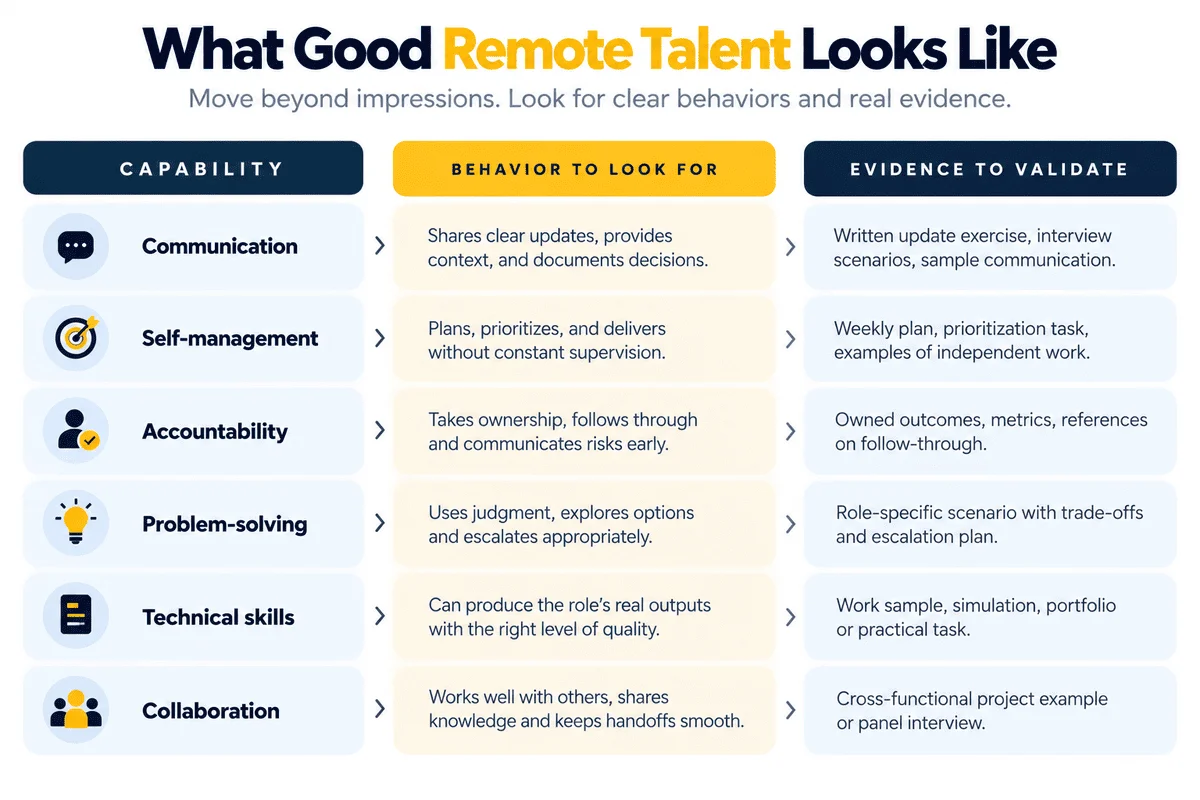
Remote Raven‘s approach to talent assessment is designed to reduce bias, avoid overvaluing presentation, and align hiring decisions with how the role will operate inside a distributed team.
- Application/résumé review: Look for role relevance and clarity of ownership—not just brand names.
- Structured interview: Ask consistent questions tied to the role’s competencies. (OPM guidance supports structured interviews when applied consistently.)
- Behavioral questions: Probe for ownership, deadlines, and problem-solving under constraints.
- Skills assessment: Validate technical ability with a role-specific task or portfolio walkthrough.
- Work sample or simulation: Mirror real work (with a time box) to see quality, judgment, and speed.
- Communication assessment: Test written clarity and whether they include context, decisions, and next steps.
- Reference/background validation: Confirm reliability, follow-through, and how they handled setbacks.
- Final alignment check: Confirm learning agility & team fit—ways of working, values, and expectations.
Important: Not every role needs every step. A virtual assistant role may require heavier written communication and process-following tests, while a senior operator may need deeper scenario judgment and stakeholder management evaluation.
|
What You Need to Assess |
How to Assess It |
|
Communication |
Written task, project update exercise, structured interview |
|
Technical ability |
Work sample, portfolio review, simulation, skills test |
|
Problem-solving |
Role-specific scenario with trade-off discussion |
|
Self-management |
Weekly planning exercise and prioritization questions |
|
Accountability |
Behavioral interview on owned outcomes and missed deadlines |
|
Digital fluency |
Tool walkthrough and learning-adaptability questions |
|
Collaboration |
Stakeholder project example or panel conversation |
|
Adaptability/reliability |
Change example, reference checks, process responsiveness |
What are the biggest red flags when hiring Remote Talent?
Red flags in remote hiring are signals that you need more evidence—not automatic disqualifiers. Used well, they help you target follow-up questions and reduce risk before you make an offer.
Remote Raven uses these red flags to identify where the hiring team needs deeper validation:
- Vague ownership claims: Ask what the candidate personally delivered and how success was measured.
- Slow or unclear communication: Determine whether expectations were misunderstood or habits are weak by testing written updates.
- No system for managing work: Explore how they plan, track, and prioritize across competing requests.
- Blaming previous teams: Look for accountability and learning, not perfection.
- Tool resistance: Check digital adaptability rather than requiring identical platform experience.
- Overconfidence without evidence: Request work samples, metrics, or concrete examples.
- Discomfort with feedback: Probe how they respond to revisions and changing priorities.
How to Decide If a Candidate Is Ready for Remote Work
Decide based on evidence of both role capability and remote-work behaviors—not on how polished someone feels in an interview.
- Strong candidate: Has the technical ability and consistently demonstrates communication, self-management, accountability, adaptability, and collaboration required by the role.
- Needs further assessment: Likely has technical ability, but has limited evidence of remote-work behaviors (unclear updates, weak prioritization systems, fuzzy ownership). Add a work sample or communication exercise.
- High risk: Requires constant direction, avoids accountability, struggles with communication, cannot demonstrate ownership, or lacks the required technical skills for the role’s core outputs.
Need Help Finding the Right Remote Talent?
Hiring remote talent takes more than posting a job and reviewing résumés. Remote Raven offers a structured remote staffing solution to help you define the role, find qualified candidates, validate skills and work behaviors, and match the right person to how your team operates. If you’re unsure where to start, book a free 30-minute consultation with Remote Raven to discuss your hiring needs, role requirements, and the right remote staffing solution for your business.
Conclusion: Hire for outcomes in a distributed environment
Hiring remote talent isn’t just about finding someone who can do the job from a different location. It’s about finding someone who can consistently deliver results inside a distributed working environment—through clear communication, strong self-management, real accountability, and the judgment to solve problems without constant supervision.
Remote Raven‘s approach to remote staffing starts with the business problem and the outcomes the role must deliver. Then we validate the skills and working behaviors that make those outcomes reliable—so you can build distributed teams that perform, onboard faster, and require less firefighting.
Want help building a repeatable remote hiring process? Book a free 30-minute strategy call with Remote Raven to discuss role outcomes, assessments, and how to identify remote talent that delivers reliably in your distributed team.
Frequently Asked Questions About Hiring Remote Talent
1) What should you look for when hiring Remote Talent?
Look for role-specific capability plus proof of remote-work behaviors: communication, self-management, accountability, reliability, problem-solving, digital fluency, adaptability, and collaboration. Remote hiring is different because leaders see fewer informal signals, so you need evidence of how someone plans work, keeps progress visible, escalates risks, and delivers outcomes without constant supervision.
2) What are the most important qualities of a Remote Employee?
The highest-leverage qualities are communication, self-management, and accountability—because they determine whether autonomy creates speed or chaos. Technical ability still matters, but remote employees must also keep work visible, document decisions, coordinate handoffs, and take ownership when priorities shift. The best remote talent combines execution skill with strong operating habits.
3) How do you assess remote talent before hiring?
Use a structured process that combines interviews with evidence: a written communication exercise, a role-specific work sample or simulation, scenario-based problem-solving questions, and reference checks focused on outcomes and follow-through. Remote Raven‘s approach is to test the behaviors that make autonomy productive, not just the candidate’s ability to describe past work.
4) What should I ask when interviewing a remote employee?
Ask questions that reveal working behavior: “How do you plan your week?” “How do you keep stakeholders updated?” “Tell me about a missed deadline—what happened and what changed?” “When do you escalate vs. decide independently?” “How do you learn new tools?” These questions surface ownership, judgment, and communication habits that matter in distributed teams.
5) What are the biggest red flags when hiring remote employees?
Common red flags include vague ownership, unclear written communication, no system for prioritizing, resistance to tools or process, and avoiding accountability when something goes wrong. A single red flag isn’t automatic rejection—but it should trigger a targeted assessment (work sample, written update, scenario question, or reference check) to reduce risk.
6) Is remote hiring different from traditional hiring?
Yes. Remote hiring requires stronger validation of behaviors that are less visible day-to-day—communication, self-management, accountability, and collaboration across tools and time zones. Traditional hiring often relies on proximity-based assumptions (“we’ll coach them in person”). Remote staffing works best when you define outcomes clearly and test how candidates operate inside a distributed workflow.
7) Should remote employees have previous remote work experience?
Remote experience can help, but it shouldn’t be a strict requirement. What matters more is evidence of remote-ready behaviors: written clarity, proactive updates, comfort with tools, and the judgment to solve problems independently while escalating appropriately. With the right assessment and remote onboarding plan, first-time remote hires can succeed.