

Key Takeaways
- HIPAA compliance in remote healthcare staffing begins with role clarity: identify covered entities, business associates, workforce members, and subcontractors before granting access to PHI.
- Remote teams need documented safeguards for access, devices, networks, workspaces, communications, training, and monitoring—not just a signed policy.
- A Business Associate Agreement (BAA) is required when the relationship meets HIPAA’s business associate criteria; not every remote worker or staffing arrangement automatically requires one.
- Use role-based permissions, unique accounts, multifactor authentication, approved tools, and prompt offboarding to reduce avoidable exposure.
- Incident response should document and assess suspected events promptly, distinguishing security incidents from breaches that trigger notification obligations.
- Vendor due diligence should verify actual procedures, training, contractual commitments, subcontractor controls, and incident escalation—not rely on marketing claims alone.
- Remote Raven’s healthcare staffing and relevant technology services can support remote operating workflows, while HIPAA obligations remain with the regulated organization and its advisers.
How Can Healthcare Organizations Ensure HIPAA Compliance When Using Remote Healthcare Staffing?
Healthcare organizations can support HIPAA compliance in remote healthcare staffing by defining each party’s HIPAA role, limiting access to protected health information (PHI) according to job duties, signing business associate agreements where required, applying appropriate administrative, physical, and technical safeguards, training staff by role, monitoring activity, and maintaining a documented incident-response process.
At Remote Raven, we view compliance as an operating model—not a hiring checkbox. The staffing decision, technology environment, contracts, onboarding process, and ongoing supervision must work together. Our healthcare staffing services help practices explore remote support roles, but the right safeguards must be assessed for each specific engagement.
HIPAA does not prohibit remote healthcare staffing. It does require covered entities and business associates to protect PHI and electronic PHI (ePHI) with appropriate safeguards and accountability. The relevant risk depends on the work performed, the information accessed, the parties involved, the technologies used, and the legal obligations that apply.
What HIPAA Basics Matter Most for Remote Healthcare Teams?
The three foundations are the HIPAA Privacy Rule, Security Rule, and Breach Notification Rule. Together, they govern permissible uses and disclosures of PHI, safeguards for ePHI, and required responses after certain breaches of unsecured PHI.
The Privacy Rule sets limits and conditions on uses and disclosures of PHI. For many operational activities, the minimum necessary standard means limiting access and use to what is reasonably needed for the task. A scheduler should not need the same access as a clinician, and a billing support role may require a different view of records from a patient-intake role.
The Security Rule requires administrative, physical, and technical safeguards for ePHI. In a remote environment, those safeguards can include documented policies, workforce training, access controls, workstation protections, device and media controls, secure remote access, and appropriate logging. Controls should be selected through risk analysis and applied to the organization’s actual environment.
The Breach Notification Rule addresses notifications following breaches of unsecured PHI. An impermissible use or disclosure is generally presumed to be a breach unless an applicable exception applies, or a documented risk assessment demonstrates a low probability that the PHI was compromised. Review the current HHS HIPAA Security Rule guidance and HHS breach notification guidance when developing policies.
Who Must Comply with HIPAA When Healthcare Work Is Performed Remotely?
Correctly classifying the people and organizations involved is foundational to HIPAA compliance in remote healthcare staffing. A covered entity may be a health plan, healthcare clearinghouse, or certain healthcare providers that conduct specified electronic transactions. A business associate generally performs functions or services for a covered entity that involve PHI, outside the organization’s workforce.
A subcontractor that creates, receives, maintains, or transmits PHI on behalf of a business associate may itself be a business associate. By contrast, a workforce member can include employees, volunteers, trainees, and other persons whose conduct is under the direct control of the covered entity or business associate. A workforce member is not treated as a business associate of that same organization merely because the person works remotely.
Before onboarding, document the relationship and responsibilities. For ambiguous arrangements, involve qualified HIPAA counsel rather than relying on the job title alone.
What Are the Biggest HIPAA Compliance Risks in Remote Healthcare Staffing?
Remote work can improve flexibility and access to talent, but it changes where PHI may be viewed, transmitted, discussed, or mishandled. The main risks are usually gaps in identity and access management, endpoint security, workspace privacy, network protection, training, supervision, and vendor oversight.
- Overbroad access: workers can view more records than their role requires.
- Unmanaged devices: personal computers or phones may store or display PHI without adequate controls.
- Weak authentication: shared accounts or passwords without multifactor authentication can increase account-takeover risk.
- Exposed workspaces: family members, visitors, or roommates may see screens or overhear calls.
- Uncontrolled downloads: screenshots, spreadsheets, and copied notes may move PHI outside approved systems.
- Delayed reporting: workers may not know whom to contact after a mistake or suspicious event.
- Vendor blind spots: subcontractors may handle PHI without appropriate due diligence, agreements, or oversight.
The practical response is to design safeguards before credentials are issued. Define which systems are necessary, what information may be accessed, which activities are prohibited, how work is logged, and how a worker should report a concern.
How Should Healthcare Organizations Assess HIPAA Compliance Before Hiring Remote Staff?
A pre-engagement assessment should confirm role fit, expected PHI exposure, technology requirements, contractual responsibilities, and the candidate’s ability to follow documented procedures. It should be proportionate to the sensitivity of the work and the risks identified.
- Map the role: Identify whether the work involves scheduling, intake, billing, transcription, coding, care coordination, IT support, or another function.
- Review PHI exposure: Document what information the worker needs and remove unnecessary access from the planned workflow.
- Screen appropriately: Conduct lawful background and reference checks consistent with organizational policy and applicable law.
- Confirm technology readiness: Define requirements for managed devices, virtual desktops, approved networks, and authorized applications.
- Document expectations: Obtain acknowledgments of confidentiality, acceptable use, sanctions, and incident-reporting procedures.
- Test judgment: Use realistic scenarios involving misdirected messages, overheard calls, suspicious emails, or inappropriate requests for records.
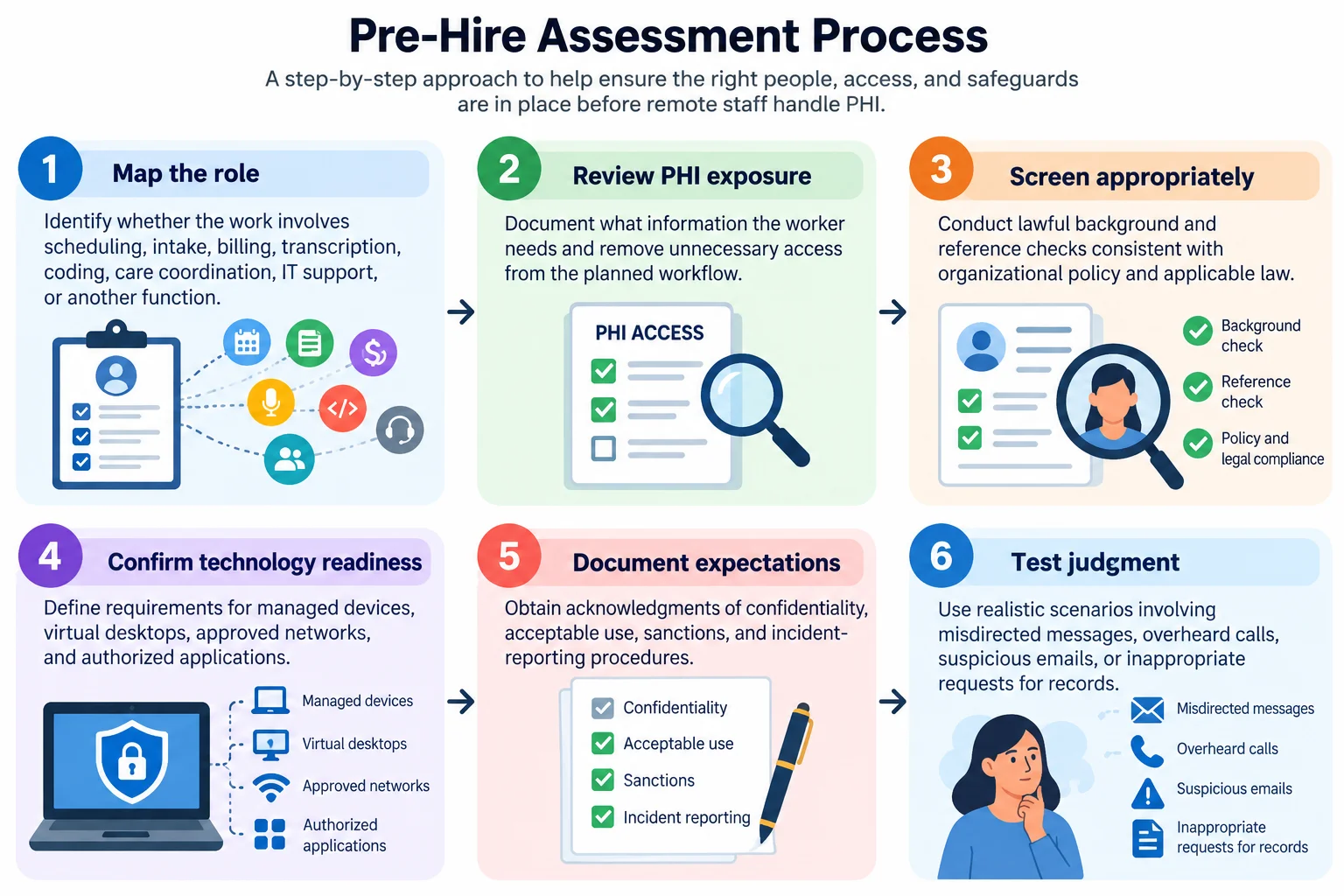
This assessment should connect to a documented onboarding process. A pre-hire review does not replace ongoing training, supervision, or legal review.
When Is a Business Associate Agreement (BAA) Required for Remote Healthcare Staffing?
A BAA is generally required when a vendor or other outside party qualifies as a business associate because it creates, receives, maintains, or transmits PHI on behalf of a covered entity or another business associate. A BAA is not automatically required just because a person works remotely.
HHS provides sample BAA provisions covering permitted uses and disclosures, safeguards, reporting of improper uses or disclosures, subcontractor obligations, and return or destruction of PHI at termination where feasible. The agreement should reflect the actual services and relationship rather than serve as a generic form.
|
Arrangement |
Is a BAA typically required? |
Practical note |
|
Remote employee under the organization’s direct control |
Usually no separate BAA |
Typically treated as a workforce member; use policies, training, access controls, and supervision. |
|
Contractor under direct control |
Depends on the facts |
Classification depends on the actual relationship and applicable law; ask counsel if unclear. |
|
Staffing or managed-services vendor handling PHI on the organization’s behalf |
Often yes |
Assess whether the vendor meets the business associate definition and define safeguards and reporting duties. |
|
Technology provider that maintains or transmits ePHI |
Often yes |
A vendor may qualify as a business associate even when it does not routinely view the information. |
|
Subcontractor handling PHI for a business associate |
Often yes |
Appropriate downstream contractual protections may be required. |
How Can Healthcare Organizations Secure Devices, Networks, and Remote Access?
Remote access should be designed around least privilege, strong identity controls, managed endpoints, secure connections, and auditable activity. The goal is to make approved work straightforward and unauthorized work difficult.
- Use unique user IDs for every worker; avoid shared logins.
- Enable multifactor authentication for email, EHRs, billing systems, remote desktops, VPNs, and administrative tools.
- Assign role-based access aligned to job duties and review permissions regularly.
- Use managed devices or properly configured virtual desktops to control local storage, printing, copying, and downloads where appropriate.
- Encrypt devices and data in transit, and protect backups.
- Enable automatic screen locking and privacy protections for workspaces.
- Maintain patching, endpoint protection, secure configurations, and asset inventories.
- Set clear Wi-Fi and remote connection standards; prohibit unapproved tools and unsafe workarounds.
- Retain and review relevant logs for access, exports, failed logins, and unusual activity.
The HIPAA Security Rule is flexible enough to account for different environments, but flexibility does not make safeguards optional. Controls should be selected and documented based on risk analysis, the organization’s systems, and applicable requirements.
Any technology used with ePHI must be assessed and configured for specific engagement.
How Can Healthcare Organizations Protect Patient Information During Everyday Remote Work?
Policies become effective when they translate into repeatable daily habits. Remote healthcare professionals should understand how PHI may be viewed, discussed, documented, transferred, and disposed of—and what to do when something goes wrong.
- Verify identity before discussing appointments, billing, records, or clinical details.
- Use only approved systems for PHI, including authorized EHR, phone, messaging, ticketing, and file transfer tools.
- Avoid saving PHI to personal email, personal cloud drives, or unmanaged local folders.
- Keep workspaces private, position screens away from others, and use headsets for calls where appropriate.
- Apply minimum-necessary access when searching records or preparing operational reports.
- Report misdirected messages, accidental access, suspicious requests, and lost devices immediately.
- Follow approved clean-desk, printing, secure return, and disposal procedures.
For healthcare practices considering administrative support, these tasks should be assigned with clear permissions, approved systems, and documented escalation boundaries.
What HIPAA Training Should Remote Healthcare Professionals Receive?
Training should reflect the worker’s actual role, systems, and decisions. A generic awareness session alone may not prepare someone who handles PHI through EHR workflows, email, phones, chat tools, or ticket queues.
- Schedulers and intake staff: identity verification, appointment details, voicemail, and patient communications.
- Billing and revenue-cycle staff: claims data, payer portals, payment discussions, and minimum-necessary access.
- Care coordination support: sensitive conversations, documentation boundaries, and escalation paths.
- IT and technical support: privileged access, logging, backups, system changes, and incident escalation.
- Supervisors: access approvals, quality checks, coaching, sanctions, and documentation.
Training should include realistic scenarios, policy acknowledgments, and documented completion. Repeat it during onboarding, when responsibilities or systems change, and after relevant incidents.
How Can Healthcare Organizations Monitor Compliance After Remote Staff Are Onboarded?
Compliance does not end after the first login. Ongoing oversight helps confirm that remote staff follow policies, access appropriate records, and report problems promptly.
- Review access at defined intervals and whenever roles or responsibilities change.
- Review relevant EHR and system audit logs and investigate unusual activity.
- Configure alerts for suspicious downloads, repeated failed logins, or access patterns that warrant review.
- Conduct supervisor quality checks on calls, tickets, documentation, and workflows, consistent with policy and applicable law.
- Deactivate accounts and revoke credentials promptly when an assignment ends.
- Use observed errors to target retraining and improve procedures.
- Document corrective actions and apply sanctions consistently where appropriate.
Monitoring should be transparent, proportionate, and tied to written policy. Workers should understand that activity in systems containing PHI may be logged and reviewed for security, quality, and compliance purposes. Reviews should also be conducted by authorized personnel and handled with appropriate confidentiality.
What Should Incident Response Look Like for Remote Teams?
An incident-response plan should give remote workers a clear route to report suspected events, preserve evidence, contain risk, and support breach analysis. A security incident is not automatically a reportable breach, but every suspected exposure should be reviewed promptly.
A response plan should identify the designated privacy and security contacts and explain how to report events outside normal working hours. The response team should evaluate the nature of the PHI, the unauthorized recipient, whether the information was actually acquired or viewed, and the extent to which risk was mitigated, along with applicable exceptions and requirements.
- Report: Notify the designated privacy or security contact promptly.
- Contain: Disable access, retrieve messages where possible, secure accounts, or isolate affected devices.
- Document: Record relevant dates, systems, people, information involved, and actions taken.
- Assess: Involve privacy, security, legal, and compliance personnel to determine whether the event constitutes a breach and what obligations apply.
- Notify: Complete notifications when required under applicable rules and within the relevant deadlines.
- Improve: Update training, permissions, procedures, or vendor controls based on the findings.
Consult the current HHS Breach Notification Rule guidance for applicable requirements. Do not assume that every incident has the same notification requirements; the facts and applicable rules matter.HHS Breach Notification Rule guidance
How Should Healthcare Organizations Evaluate Remote Staffing Vendors?
Vendor evaluation should test whether a provider can support secure, accountable operations before PHI access begins. Review the contractual relationship, workforce practices, technical safeguards, subcontractors, incident reporting, and ability to provide evidence of relevant procedures.
- Will the vendor sign a BAA when required, and can it explain its HIPAA role?
- How are workers screened, trained, supervised, and retrained?
- Are unique accounts, MFA, least-privilege access, and approved device standards supported?
- How are local storage, printing, downloads, and unapproved applications controlled?
- Are subcontractors identified, assessed, and bound to appropriate safeguards where required?
- How quickly must suspected incidents or improper disclosures be escalated?
- Can the vendor document training, access approvals, offboarding, and corrective actions?
- What controls can be evidenced through policies, records, configuration reviews, or redacted procedures?
- Does the provider avoid suggesting that its involvement automatically makes the healthcare organization compliant?
|
Evaluation area |
Question to ask |
Evidence to request |
|
Role and contracting |
Will you execute a BAA when required? |
Draft or executed agreement; incident-reporting and subcontractor terms. |
|
Training |
How are staff trained by role? |
Training curriculum, completion records, retraining and sanctions procedures. |
|
Identity and access |
Are unique accounts, MFA, and least privilege used? |
Access workflow, MFA policy, offboarding checklist, review records. |
|
Devices and remote access |
How are endpoints protected and data contained? |
Device standards, encryption and patching requirements, approved-tools list. |
|
Monitoring and incidents |
How are anomalies reviewed and incidents escalated? |
Logging policy, escalation runbook, incident templates, corrective-action process. |
|
Subcontractors |
Can subcontractors access PHI and how are they governed? |
Subcontractor list, due-diligence process, contractual flow-down terms. |
Strong vendors should be able to answer specific questions and explain the limits of their role. A marketing claim, signed agreement, or generic certification alone does not prove that a particular staffing arrangement is compliant.
How Can Remote Raven Help Healthcare Organizations Build a Safer Remote Staffing Model?
Remote Raven supports healthcare organizations seeking remote professionals for defined administrative and operational workflows. The right engagement begins by understanding the work, identifying the systems and information involved, and aligning role expectations with the client’s policies, technical controls, and compliance review.
Depending on the requirements of the practice, relevant options include virtual medical assistants, virtual medical receptionists, medical billing support, medical coding support, medical transcriptionists, and virtual nurses. Each role should be scoped according to the work it will perform, the qualifications required, and the level of access permitted.
Operationally, a staffing partner can help clarify responsibilities, align a role with the practice’s needs, and coordinate onboarding expectations. Where secure cloud workstations or managed technology are considered, the specific configuration, access controls, contracts, and safeguards must be reviewed for the engagement. Remote Raven does not replace a client’s compliance officer, privacy officer, security officer, or legal counsel, and no staffing partner can make every client organization automatically HIPAA compliant.
If your practice is evaluating remote staffing, explore Remote Raven’s healthcare services and discuss your workflow, staffing needs, and security requirements with the team. You can book a free consultation and use the conversation to identify the questions your compliance and IT advisers should resolve before access is granted.
What Are the Most Important Steps for Maintaining HIPAA Compliance in Remote Healthcare Staffing?
Before granting remote access to PHI, confirm that your organization has completed the essentials:
- Classify each worker and vendor correctly as workforce, business associate, subcontractor, or another appropriate role.
- Execute BAAs where required and review subcontractor obligations.
- Assess PHI exposure by role and apply least-privilege access.
- Require unique accounts, MFA, secure remote access, appropriate device protections, and relevant logging.
- Document rules for communications, downloads, printing, local storage, and disposal.
- Complete role-specific HIPAA and security training before access begins.
- Monitor access and quality after onboarding and remove permissions promptly when no longer needed.
- Maintain an incident-response plan with breach-assessment and notification steps.
- Evaluate staffing and technology vendors using a documented, evidence-based checklist.
- Reassess controls when roles, systems, vendors, or workflows change.
The core principle is straightforward: safe remote healthcare staffing requires clear accountability, appropriate safeguards, and continuous oversight—not merely a signed contract or a one-time training session. Remote Raven can help practices explore staffing options and role requirements. Contact the team to discuss your goals and the operating requirements that should shape your remote staffing model.
Frequently Asked Questions About HIPAA Compliance in Remote Healthcare Staffing
Is remote healthcare staffing allowed under HIPAA?
Yes. HIPAA does not prohibit remote staffing. Covered entities and business associates must protect PHI and ePHI wherever work occurs. Remote workers should use approved systems, appropriate access permissions, secure connections, and documented procedures. Requirements depend on the parties, the information involved, and the actual work being performed.
Does every remote healthcare worker need a BAA?
No. A BAA generally applies to a business associate relationship; not a person acting as a workforce member under an organization’s direct control. A staffing agency, technology provider, or subcontractor that handles PHI on behalf of a covered entity or business associate may require a BAA, depending on the relationship and services.
What is the biggest HIPAA risk with remote staff?
A major risk is uncontrolled access: people or systems accessing more PHI than necessary without sufficient oversight. Shared credentials, unmanaged devices, local downloads, weak authentication, and unclear incident-reporting expectations can contribute. Role-based access, MFA, training, approved tools, and monitoring help reduce exposure.
Can remote staff use personal devices for PHI work?
Personal-device use should be carefully assessed and governed. If permitted, safeguards may include encryption, screen locks, patching, endpoint protection, remote-wipe capability, restricted local storage, and approved access methods. Some organizations choose managed devices or appropriately configured virtual desktops to improve control.
What should HIPAA training include for remote workers?
Training should cover permitted PHI use, role-appropriate access, secure communications, identity verification, phishing, device security, workspace privacy, incident reporting, and realistic scenarios tied to the worker’s tasks. Organizations should document completion and provide additional training when roles, systems, policies, or risks change.
What is the difference between a security incident and a breach?
A security incident is a suspected or actual event that requires review. A breach generally involves an impermissible use or disclosure of PHI that compromises privacy or security, subject to applicable exceptions and risk-assessment requirements. Organizations should document and escalate incidents promptly so qualified personnel can determine what obligations apply.
How often should remote access be reviewed?
Review access before onboarding, when duties change, after relevant incidents, and at intervals appropriate to the organization’s risk. Access should be revoked promptly when a worker leaves or no longer needs it. Documented periodic reviews help identify permissions that have become unnecessary.
Can Remote Raven make my organization HIPAA compliant?
No staffing provider can automatically make a healthcare organization HIPAA compliant. Remote Raven can help explore staffing and operational workflows, but the client must assess the engagement, apply appropriate safeguards, and involve its privacy, security, compliance, and legal advisers. Any specific service or technical control should be confirmed for the arrangement.
What should we ask a remote staffing vendor before sharing PHI?
Ask whether the vendor will sign a BAA when required, how workers are screened and trained, which access and device controls are used, how subcontractors are governed, and how incidents are escalated. Request evidence of relevant procedures and confirm offboarding steps. Avoid relying on vague assurances or broad marketing claims.
Can overseas remote staff access U.S. patient information?
HIPAA does not categorically prohibit all overseas access, but the arrangement requires careful legal, contractual, security, and operational review. The organization should assess who will access PHI, the applicable obligations, risks, safeguards, vendor relationships, and any additional laws or contractual restrictions that may apply. Obtain qualified advice before enabling access.