


Key takeaways
- Remote staffing is a system, not just a hire. The person matters, but so do role design, tools, security, onboarding, and performance management.
- Start with the business problem. The clearest path is Problem → Tasks → Responsibilities → Role → Skills → Candidate → KPIs.
- Remote Raven’s 8-stage framework — Define, Design, Discover, Validate, Select, Equip, Integrate, Measure — reduces hiring, productivity, and security risk.
- Validate capability, not just experience. Pair résumé review with role-relevant assessments and communication checks.
- Secure access is part of staffing. Password management, MFA, secure remote access, and cloud workstations help remote employees work effectively without increasing risk.
- Onboarding and outcomes-based management determine success. A planned first 30 days and KPI-driven coaching beat visibility-based monitoring.
Remote staffing works by turning a business need into a remote-ready role, sourcing and validating candidates, hiring the right person, equipping them with secure tools, onboarding them into daily workflows, and measuring performance after they start. Done well, it is not simply “hiring someone to work from home.” It is a complete workforce system built around role clarity, communication, technology, security, management, and measurable outcomes.
Remote Raven approaches remote staffing as that full system: talent plus infrastructure. As a US-based remote staffing agency, Remote Raven connects businesses with vetted global talent while also supporting technology, cybersecurity, cloud workstations, VoIP, and password-management infrastructure.
How does Remote Staffing work from job description to first day?
Remote staffing works by defining the business problem first, designing a remote-ready role, choosing the right staffing model, finding candidates, screening and assessing them, completing hiring and compliance steps, setting up secure tools, and onboarding the person into the team. The first day should feel planned, not improvised.
A strong remote staffing process starts before recruiting. If the role is vague, the staffing outcome will be vague. If the role is designed around outputs, communication rhythms, time-zone expectations, tools, and security, the new hire can contribute faster and with less manager friction.
- Define the business problem. Identify the workload, bottleneck, or growth constraint the role must solve.
- Design the role. Clarify skills, hours, time-zone overlap, reporting line, KPIs, tools, and budget.
- Choose the staffing model. Decide whether you need a remote employee, virtual assistant, freelancer, outsourcing partner, or local hire.
- Source talent. Build a candidate pool using the role requirements, not a generic job post.
- Screen candidates. Check experience, communication ability, availability, tool fluency, and fit.
- Interview and assess. Use structured questions and practical work samples tied to real tasks.
- Hire with compliance in mind. Employment classification, payroll, tax, data, and labor requirements vary by jurisdiction.
- Equip the worker. Provide email, project management tools, password management, MFA, secure access, storage, VoIP, collaboration tools, and — where appropriate — a secure cloud workstation.
- Onboard deliberately. Teach the role, team norms, workflows, decision rights, and success measures.
- Manage and measure performance. Use KPIs, check-ins, documentation, feedback, and continuous improvement.
Remote Raven follows this same principle in its remote staffing process: understand the business need, recruit against it, vet the candidate, and create the conditions for that person to perform.
Remote staffing is a workforce system, not a work-from-home shortcut
Remote staffing is the coordinated design of people, process, management, and technology so work can happen reliably outside one shared office. The staffing decision matters, but the operating system around the person matters just as much: documentation, access control, communication norms, supervision, training, and performance measurement.
This distinction matters because many remote staffing problems are not talent problems. They are system problems. A capable bookkeeper can still fail if they do not have clean workflows, secure access, a clear approval path, or a manager who knows what “good” looks like.
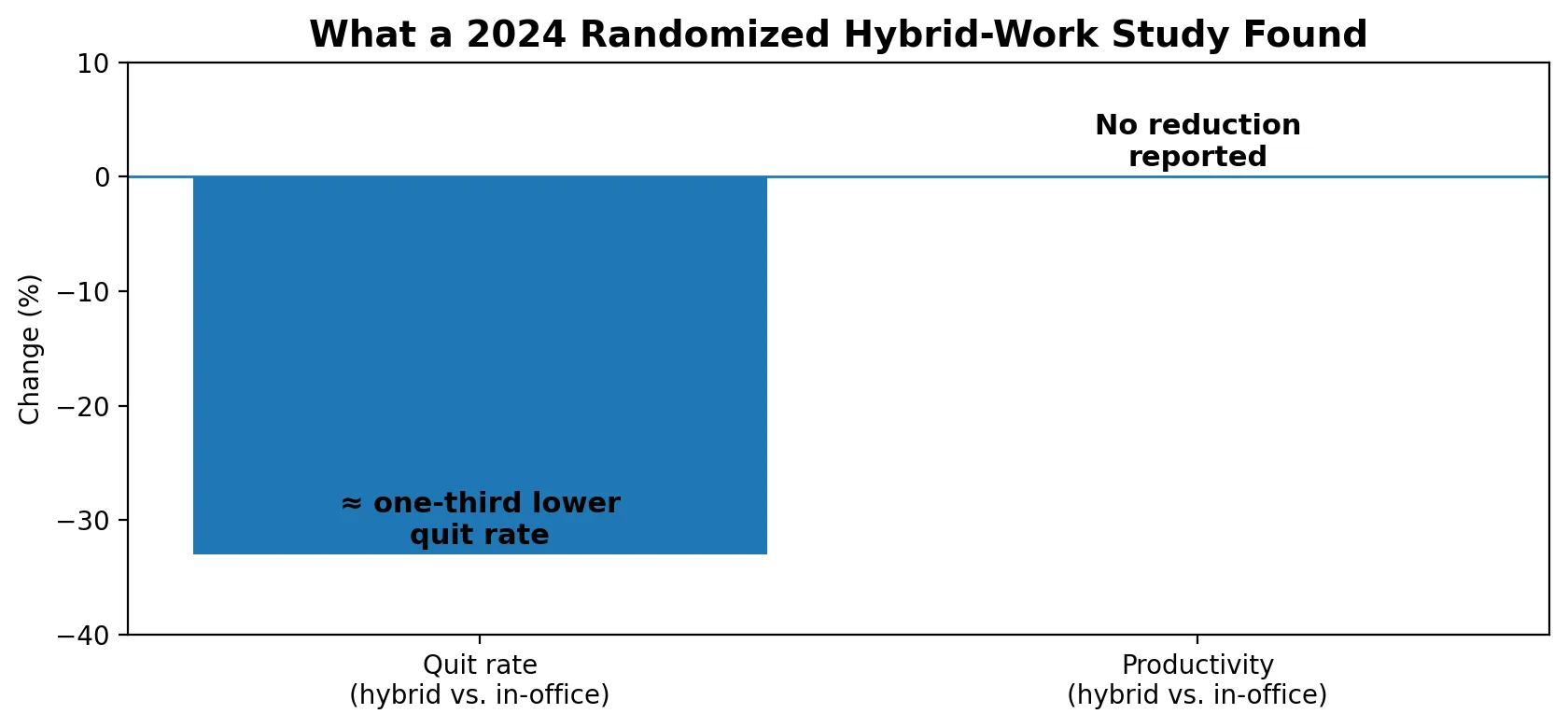
A 2024 randomized study published in Nature involving 1,612 Trip.com employees found that a two-day-a-week hybrid arrangement reduced employee attrition by about one-third without reducing performance or promotion outcomes. The finding does not mean every role should be hybrid; it demonstrates how work design and management conditions influence outcomes.
Remote Raven’s position is that remote staffing should combine recruitment discipline with secure remote-work infrastructure. That means thinking through who will do the work, how they will access systems, which tools they will use, how passwords are protected, how calls are routed, how files are stored, and how managers will know whether work is on track.
The Remote Raven Remote Staffing Framework
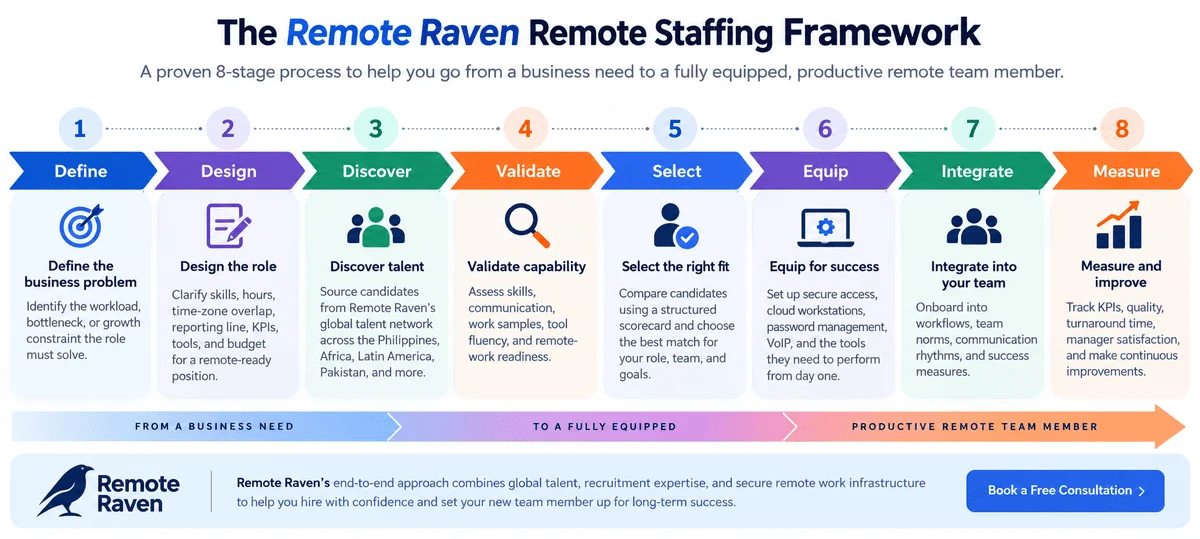
The Remote Raven Remote Staffing Framework moves through eight ordered stages: Define, Design, Discover, Validate, Select, Equip, Integrate, and Measure. Each stage addresses a different risk, from hiring for the wrong role to exposing systems, confusing the new hire, or managing without useful performance signals.
1. Define
Define the business problem before defining the person. Is the company losing billable time to admin? Are client requests waiting too long? Is a founder buried in scheduling, inbox triage, invoicing, or follow-up? “We need help” is not enough. A clear operational problem produces a much clearer remote role.
2. Design
Design converts the problem into a remote-ready job description. Include skills, expected hours, time-zone overlap, reporting structure, communication channels, KPIs, tools, budget, and access needs. This prevents role drift.
3. Discover
Discover is the sourcing stage. The objective is not to collect the largest possible pile of résumés; it is to find people whose experience, availability, communication style, and working conditions match the role. The World Economic Forum’s Future of Jobs Report 2025 found that 63% of employers identify skills gaps as a major barrier to business transformation, making skills-based sourcing increasingly important.
4. Validate
Validate means checking whether the candidate can actually do the work in a remote environment. Screening should include work history, tool familiarity, communication quality, availability, and practical judgment. Where appropriate, use work samples or scenario-based assessments.
5. Select
Select is the decision stage. The best choice is not always the person with the most impressive résumé. It is the person whose strengths, constraints, work style, and expectations match the job design. Remote Raven uses recruitment specialists and candidate vetting to narrow the field before the client makes the final choice.
6. Equip
Equip turns a selected candidate into a secure, functional remote worker. Remote Raven’s cloud workstation offering provides centralized management, patching and security, MFA, role-based access, and cloud-based data controls. The service can support Remote Raven VAs as well as a client’s own employees, freelancers, and contractors.
7. Integrate
Integrate brings the new worker into the team’s operating rhythm. They need to know who approves work, when to escalate, where files live, how meetings work, what “urgent” means, and how success will be reviewed.
8. Measure
Measure ensures the staffing system keeps improving. Track KPIs, quality, turnaround time, communication, responsiveness, manager satisfaction, and worker experience. The point is not surveillance. The point is visibility and timely coaching.
How should you choose the right remote staffing model?
Choose the staffing model based on the work’s continuity, sensitivity, required control, skill depth, and need for scalability.
|
Model |
Best For |
Control |
Scalability |
Typical Strength |
Typical Limitation |
|
Remote employee |
Ongoing roles with recurring responsibilities |
High |
Medium to high |
Strong continuity, team integration, role ownership |
Requires management, onboarding, and infrastructure |
|
VA |
Administrative, scheduling, inbox, CRM, and coordination support |
Medium to high |
Medium |
Flexible support for repeatable tasks |
May not fit specialized strategic work |
|
Freelancer |
Project-based work with clear deliverables |
Medium |
Variable |
Specialized skill on demand |
Less continuity and availability control |
|
Outsourcing |
Delegating a defined function or process |
Lower to medium |
High |
Process capacity and vendor-managed delivery |
Less direct control over individuals and methods |
Remote staffing makes sense when the business wants a person integrated into its workflows, culture, systems, and performance management. Outsourcing makes sense when the company wants an external provider to own a process. Freelancers make sense when work is project-based. Local hiring makes sense when physical presence is essential.
Remote Raven’s virtual assistant and remote staffing services span administrative, customer service, sales, accounting, marketing, technical, healthcare, construction, and other business functions.
The Practical 10-Step Remote Staffing Journey
- Step 1: Define the business problem. Identify work that is delayed, expensive, inconsistent, or keeping higher-value employees from doing their best work.
- Step 2: Design the role. Write down skills, hours, time-zone overlap, reporting line, KPIs, tools, budget, and decision rights.
- Step 3: Choose the staffing model. Decide whether the work needs an integrated remote employee, VA, freelancer, outsourcing partner, or local hire.
- Step 4: Source talent. Search for candidates who match the designed role and communicate outcomes clearly.
- Step 5: Screen candidates. Review experience, availability, communication, salary expectations, tool fluency, and remote-work readiness.
- Step 6: Interview and assess. Use structured interviews and role-relevant tasks rather than relying entirely on résumé claims.
- Step 7: Hire with compliance awareness. Employment classification, payroll, tax, contracts, benefits, and data requirements vary by location.
- Step 8: Equip securely. Provide business email, project-management tools, password management, MFA, secure access, cloud workstations, storage, VoIP, and productivity tools where required.
- Step 9: Onboard intentionally. Give the new hire a schedule, manager contact, tool access, workflow training, sample outputs, and early assignments.
- Step 10: Manage and measure performance. Review output, quality, speed, communication, and reliability. Manage by outcomes rather than online visibility.
Does Remote Work Actually Work? What the Research Says
Remote work can work very well, but the research does not support a lazy “remote is always better” or “remote is always worse” conclusion. The stronger conclusion is that work design matters.
The 2024 Nature study of 1,612 Trip.com employees found that hybrid work improved job satisfaction and reduced quit rates by one-third without harming performance or promotion outcomes.
Gallup’s 2025 research adds another layer: fully remote workers can be highly engaged while also facing wellbeing challenges. That is why remote staffing should be designed around communication, connection, clear expectations, and sustainable working practices.
The World Economic Forum’s Future of Jobs Report 2025 also estimates that 39% of workers’ core skills will change by 2030, with AI and big data, networks and cybersecurity, and technological literacy among the fastest-growing areas.
For Remote Raven, the implication is practical: remote staffing is an operating model, not simply a location choice. Tools, cybersecurity, onboarding, manager training, performance metrics, and communication norms are conditions for performance.
How much does remote staffing cost?
There is no universal remote staffing price because cost depends on the role, skill level, location, hours, employment model, recruiting support, compliance needs, management structure, and technology environment.
The better question is not “What is the cheapest option?” but “What total cost creates the best value and lowest operational risk?”
For Remote Raven specifically, it is important to separate the placement/search cost from the ongoing cost of the professional. We charge a $0 startup fees and clients pay only after an approved candidate has been placed. Our rate starts as low as $10/hour. The exact rate depends on the role, experience, and scope, so $10/hour is the starting point rather than a universal price.
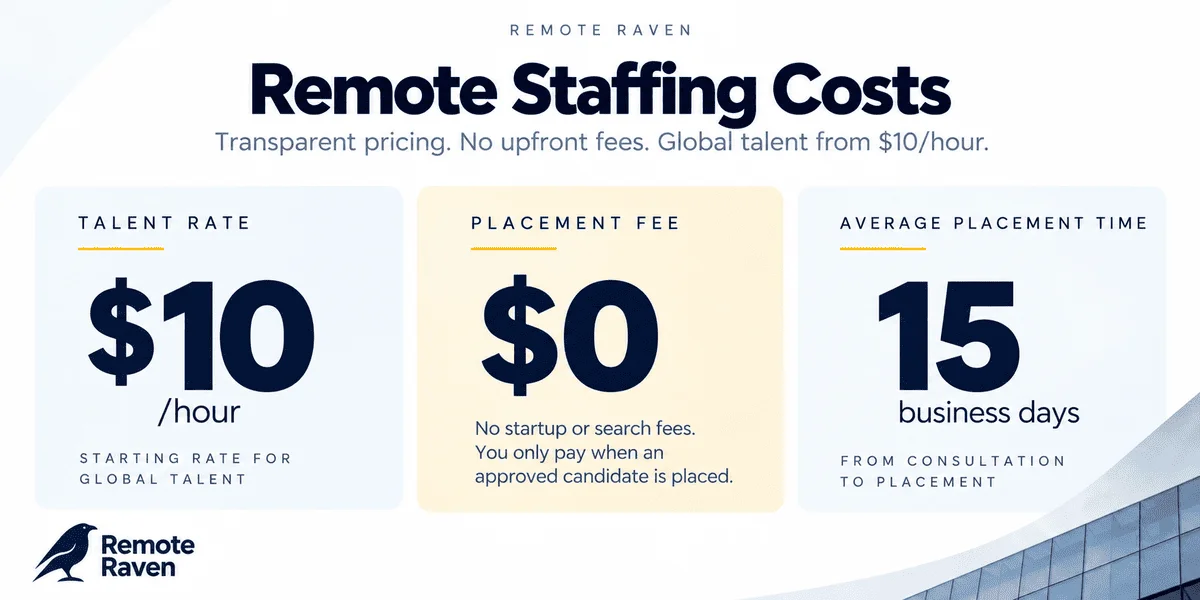
That means a business can begin a Remote Raven search without paying an upfront recruitment or search fee. Once a candidate is selected and placed, the ongoing staffing cost begins at the agreed rate.
For example, our $10/hour starting rate, a 40-hour work week is approximately $400 per week or about $1,733 per month using a 4.33-week month. This is an illustrative calculation, not a quotation; actual rates vary by position and candidate.
Businesses can also add secure infrastructure where needed. Remote Raven provides cloud workstation plans at $99 per user/month for Raven Starter, $144 for Raven Pro, and $219 for Raven Elite. These are separate technology-service prices rather than placement fees.
- Role complexity: Specialized accounting, operations, technical, or client-facing work generally costs more than basic administrative support.
- Hours and coverage: Full-time, part-time, extended-hours, and time-zone-specific coverage affect budget.
- Talent market: Candidate location, experience, language requirements, and competition influence compensation.
- Infrastructure: Devices, cloud workstations, secure access, MFA, storage, VoIP, software licenses, and password management add cost but can reduce risk.
- Recruiting and onboarding: Screening, assessments, documentation, manager time, and training are part of the investment.
- Compliance support: Payroll, contracts, benefits, classification, and local requirements may require professional guidance.
See Remote Raven’s current remote staffing offering and starting rate, or book a free consultation to discuss the role and receive role-specific pricing.
An adaptable 30-day remote onboarding framework
A 30-day onboarding plan gives structure without pretending every organization works the same way.
Days 1–5: Access, Context, and Confidence
Start with the welcome call, manager introduction, team directory, communication norms, schedule, role overview, and tool walkthrough. Confirm access to email, chat, project management, password management, MFA, secure remote access, cloud workstation, storage, VoIP, and required productivity tools.
Week 2: Workflow Practice
Move from orientation to repeatable workflows. Have the new hire shadow tasks, complete documented processes, ask questions, and receive fast feedback. Clarify quality standards, turnaround expectations, escalation paths, and examples of good work.
Week 3: Ownership with Support
Increase responsibility. The employee should own a defined set of recurring tasks while the manager reviews output, communication, and judgment.
Week 4: Performance Rhythm
By week four, the worker should understand the meeting cadence, KPIs, priorities, and communication expectations. Hold a 30-day review covering wins, gaps, access issues, workflow friction, and next-month goals.
Remote Raven’s cloud workstation service provides a pre-configured, centrally managed environment for secure remote worker access control.
Hypothetical Remote Staffing Examples
Hypothetical example: Accounting firm. A growing accounting firm needs help with transaction categorization, document collection, client reminders, and reconciliation support. A remote staffing plan would define confidentiality requirements, accounting software access, review checkpoints, turnaround KPIs, and secure access before the first day.
Hypothetical example: Real Estate Team. A real estate group wants faster listing coordination and lead follow-up. A remote coordinator could manage CRM updates, showing confirmations, document routing, VoIP call handling, and calendar support while licensed agents retain responsibility for regulated activities.
Hypothetical example: Professional Services Firm. A consulting practice needs support across proposals, meeting notes, client onboarding, and project tracking. Remote staffing works best when the role is designed around deliverables, templates, project-management tools, and clear approval paths.
Hypothetical example: Founder Admin overload. A founder spends too much time on inbox triage, scheduling, vendor follow-up, and internal reminders. A remote executive assistant can create leverage if access permissions, password management, communication rules, and decision boundaries are established upfront.
Bringing remote staffing from plan to first day
Remote staffing works when the business treats it as a disciplined operating system. The job description matters, but it is only one piece. The real result comes from role design, sourcing, validation, secure infrastructure, onboarding, communication, and measurement working together.
Remote Raven’s approach is built around that full picture: finding talent and preparing the environment where that talent can perform securely.
That philosophy extends beyond hiring. Remote Raven also provides managed IT, cybersecurity, cloud workstations, VoIP, and password-management solutions for remote teams.
How Remote Raven can help (and what a free 30-minute call covers)
Remote Raven is a US-based remote staffing company connecting businesses with highly qualified professionals from around the world. Its model combines global talent sourcing with recruitment specialists, candidate vetting, and technology services that support remote work.
Remote Raven’s global staffing service covers roles ranging from administrative and executive support to accounting, customer service, sales, marketing, healthcare, construction, IT, and technical specialists.
The objective is simple: give businesses more time back. That can mean freeing founders from administrative work, adding capacity in customer support or operations, building sales-development capacity, supporting accounting functions, or finding specialized technical talent.
The process begins with a consultation, followed by a customized search and vetting process, before the client meets the shortlisted candidate.
If you want help scoping the right role and building a remote staffing plan, book a free 30-minute consultation with Remote Raven
- What business problem you’re solving and what to measure
- Whether remote staffing, a VA, freelancer, or outsourcing is the best-fit model
- Responsibilities, hours, time-zone overlap, tools, and KPIs
- What to validate in candidates and what to test
- What secure access and infrastructure you may need
- How Remote Raven can help you build the right remote team
Frequently Asked Questions
What is Remote Staffing?
Remote staffing is the process of filling roles with people who work outside your physical office, supported by remote-friendly workflows, tools, and management practices. In Remote Raven’s view, the staffing decision is only one piece. Security, onboarding, communication, and measurement are what turn a remote hire into a productive team member.
How does remote staffing work?
Remote staffing works by defining the business need, designing a remote-ready role, sourcing candidates, validating skills and reliability, selecting and hiring, equipping secure access to tools and data, onboarding into workflows, and measuring outcomes.
What is the difference between Remote Staffing and Outsourcing?
Remote staffing typically places an individual into your team so you manage the work, priorities, and performance directly. Outsourcing hands a function or process to an external provider that manages delivery with its own team and methods.
What is the difference between Remote Staffing and Freelancing?
Remote staffing is usually built around an ongoing role with recurring responsibilities and ongoing management. Freelancing is typically project-based, with a defined deliverable and less continuity.
How long does Remote Hiring take?
Remote hiring timelines vary, but Remote Raven currently states an average placement time of 15 business days. Its search process is designed to begin with a free consultation and move through sourcing, vetting, and candidate selection.
How much does Remote Raven charge for placement?
Remote Raven does not charge startup or search fees. You do not pay to begin the search; charges begin once an approved Raven has been successfully placed. Our rate starts as low as $10/hour starting rate for talent, with actual pricing varying by role and scope.
How do you onboard a remote employee?
Remote onboarding should create connection, context, clarity, capability, and accountability. A structured 30-day plan helps the new hire understand the company, learn workflows, build confidence, and produce early wins.
What technology does a remote employee need?
Most remote employees need a reliable device or secure access model, business email, chat and video tools, project management, file storage, and role-specific software. Higher-security roles may also need password management, MFA, controlled remote access, and cloud workstations.
How do you manage remote employees?
Managing remote employees works best when expectations are visible: documented workflows, clear priorities, defined response windows, and regular check-ins. Remote Raven’s perspective is to manage by outcomes, not visibility.
How do you measure remote employee performance?
Measure performance with role-specific KPIs and observable outputs: completed work, quality, turnaround time, customer satisfaction where applicable, and reliable communication.
Is remote staffing secure?
Remote staffing can be secure, but it depends on the system built around the worker. Least-privilege access, MFA, password management, approved storage, secure access, and clear onboarding and offboarding procedures all reduce risk. Remote Raven also offers cloud workstations and cybersecurity services for businesses that need stronger controls.