

Key Takeaways
- The biggest hiring problem is not necessarily a lack of technology. It is often a poorly designed recruitment process with unclear requirements, slow decisions, and insufficient capacity.
- AI should improve recruiter capability, not replace human judgment or accountability.
- Recruitment automation makes repetitive work more efficient, but automating a broken process only reproduces its weaknesses faster.
- Remote recruiters give businesses flexible recruiting capacity without requiring every capability to be built into a permanent internal team.
- The modern hiring stack is an operating model that connects AI, automation, human expertise, and flexible recruiting support.
- Businesses should decide what to automate, augment with AI, outsource, and retain internally before investing in more tools.
- Remote Raven supports distributed teams through remote staffing and complementary technology and operational services.
The Hiring Problem Is Not What Most Companies Think It Is
Businesses are investing in AI recruiting tools, automating recruitment workflows, and exploring new ways to access talent. Yet many continue to struggle with identifying qualified candidates, making timely decisions, and maintaining a consistent candidate experience.
At Remote Raven, we believe this points to a problem that technology alone cannot solve: companies are often trying to improve hiring tools before redesigning the hiring system those tools are supposed to support.
AI can analyze candidates, automate repetitive admin tasks, and help remote recruiters scale sourcing and coordination. However, it can’t fix unclear role requirements, indecisive hiring managers, inconsistent evaluation criteria, or a process without clear ownership.
The real question isn’t AI versus more recruiters—it’s whether the hiring system assigns the right tasks to technology, the right decisions to people, and matches workload to team capacity. For distributed teams, hiring must also connect to onboarding, communication, tech, security, and operational support, with the stack built around business outcomes, not tool count.
1. Why More Recruitment Technology Does Not Automatically Mean Better Hiring
Recruitment has become a challenge of throughput, trust, and decision quality. At Remote Raven, we see employers struggling to manage growing application volumes, meet stakeholder expectations, maintain candidate communication, and identify the right talent without slowing down the hiring process or making it feel impersonal. The challenge is no longer simply finding candidates; it is building a hiring system that consistently connects businesses with the right people while delivering a better experience for everyone involved.
Recruitment now hinges on throughput, trust, and decision quality. Hiring teams must juggle multi-channel applications, stakeholder needs, and candidate communication while finding credible matches without slowing or depersonalizing the process. 2026 coverage citing Greenhouse and LinkedIn Censuswide suggests more applications and harder-to-find quality talent; confirm figures and methods before publishing.
The difference between a tooling problem and a process problem
A company adds an AI screening tool to handle hundreds of job applications faster, but vague requirements, misaligned hiring managers, and delayed interview feedback still undermine decisions. A better approach is to clarify the role, define measurable criteria, assign interview responsibilities, and set feedback deadlines before using technology to support a consistent process.
Remote Raven’s approach to staffing begins with the business needs and role requirements. Read our guide to how remote staffing works, from job description to the first day for a practical view of the process.
Different interventions solve different problems:
- If candidate information is difficult to organize, AI may help.
- If interview coordination consumes excessive time, automation may help.
- If sourcing and follow-up exceed the internal team’s capacity, remote recruiting may help.
- If hiring managers cannot agree on requirements, the business needs clearer decision-making.
No single technology can solve all four problems.
2. AI Will Not Rescue a Poorly Designed Hiring Process
AI recruiting is useful when it helps recruiters analyze information, identify patterns, prepare content, and make better-informed decisions. It becomes less useful when organizations treat its outputs as unquestionable answers.
LinkedIn’s 2025 Future of Recruiting report examined how AI could improve recruiter productivity and support a more consultative role. That potential is significant, particularly when recruiters spend substantial time on repetitive information-processing tasks. However, increased productivity does not automatically mean improved hiring quality.
Where AI genuinely helps recruiters
- Talent Research: Exploring potential candidate pools and relevant skill sets.
- Resume Summarization: Organizing documented experience against agreed role requirements.
- Job Description Development: Improving clarity and identifying ambiguous requirements.
- Skills Mapping: Comparing candidate evidence with the competencies required for a role.
- Outreach Preparation: Drafting messages for recruiters to review and personalize.
- Interview Preparation: suggesting structured questions linked to role requirements.
- Pipeline Analysis: highlighting trends, delays, and potential bottlenecks in recruitment data.
These applications can reduce preparation time and help recruiters focus on more consequential work. But helping a recruiter evaluate evidence is different from allowing a tool to determine who deserves an opportunity.
Why human judgment becomes more important as AI adoption grows
AI systems can produce inaccurate summaries, overlook relevant context, reproduce biases in historical data, or make recommendations that appear more reliable than the underlying evidence warrants. A candidate with a nontraditional career path may possess the skills required for a position without following the conventional route associated with that role. This is why employers should prioritize evidence-based remote talent evaluation over assumptions based solely on résumés, job titles, or automated assessments.
NIST’s AI Risk Management Framework provides guidance for addressing risks associated with AI, including validity, reliability, privacy, transparency, and harmful bias. These considerations are especially important when technology influences employment opportunities.
Our position at Remote Raven is straightforward: AI should increase recruiter capability, not become a substitute for accountability. Businesses using AI in recruitment should establish clear rules for what tools can do, which data they may access, how outputs are validated, and where human review is required. A structured, recruiter-led approach, such as the one outlined in Remote Raven’s hiring process, helps keep candidate evaluation connected to role requirements and human judgment.
Recruiters and hiring managers must remain responsible for evaluating evidence, questionable recommendations, and making appropriate decisions. Employers should also assess whether automated employment decision tools trigger legal requirements in the jurisdictions where they operate.
As explained in Remote Raven’s remote staffing framework, effective hiring extends beyond identifying a candidate: it requires defining the role, validating the fit, supporting onboarding, and measuring outcomes.
3. Stop Automating Broken Recruitment Workflows
Recruitment automation executes predefined actions when specified conditions are met. It can schedule interviews, send reminders, update applicant tracking systems, notify hiring managers, and generate recurring reports. AI and automation are related, but not interchangeable: AI analyzes information or generates recommendations; automation executes defined workflows.
Automation is most useful when a task is repetitive, rules-based, and sufficiently predictable to follow a consistent process.
- Sending application acknowledgments.
- Coordinating interview schedules and calendar invitations.
- Reminding hiring managers to submit feedback.
- Sending approved candidate status updates.
- Tracking outstanding candidate documents.
- Updating recruitment records when a candidate changes stages.
- Distributing scheduled hiring reports.
- Maintaining recruiter task queues and follow-up reminders.
Automate predictable work before attempting to automate judgment
If interview feedback is consistently late, automated reminders and agreed response deadlines may be more effective than introducing an AI scoring engine. If screening criteria are inconsistent, structured scorecards and clearer evaluation standards should come before automating candidate ranking.
Preserve the human moments that build trust
Final-stage rejections, compensation negotiations, sensitive accommodation discussions, and significant candidate concerns often require empathy, context, and flexibility. A business can automate routine coordination while keeping these interactions human-led.
At Remote Raven, we see this as a broader principle of operational design: technology should remove unnecessary friction while preserving the judgment and communication people need from the process. The objective is not to automate as much as possible. It is to remove the right obstacles without creating new ones.
4. AI Makes Recruiter Judgment More Valuable, Not Less
As AI and automation take over more repetitive work, recruiters have an opportunity to focus on strategy, candidate relationships, market intelligence, and decision quality. This shift requires more than learning to operate new software. Recruiters must be able to interpret outputs, question assumptions, and advise hiring managers effectively.
SHRM’s 2024 research on AI in HR highlighted challenges involving privacy, resistance, trust, and limited resources to audit algorithms. These challenges demonstrate why technology adoption needs clear governance and human responsibility.
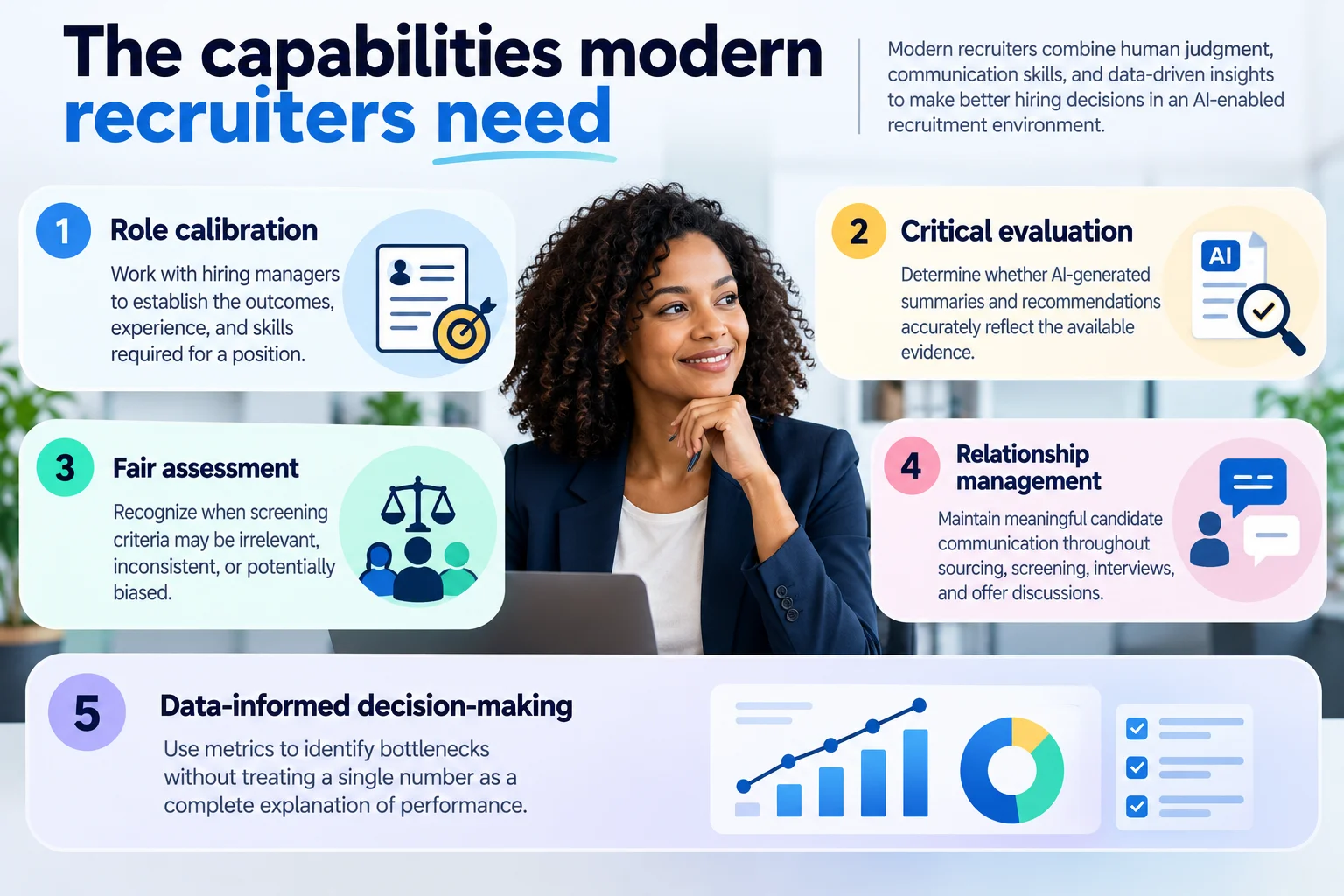
The capabilities modern recruiters need
- Role calibration: Work with hiring managers to establish the outcomes, experience, and skills required for a position.
- Critical evaluation: Determine whether AI-generated summaries and recommendations accurately reflect the available evidence.
- Fair assessment: Recognize when screening criteria may be irrelevant, inconsistent, or potentially biased.
- Relationship management: Maintain meaningful candidate communication throughout sourcing, screening, interviews, and offer discussions.
- Data-informed decision-making: Use metrics to identify bottlenecks without treating a single number as a complete explanation of performance.
At Remote Raven, we believe the value of a modern recruiter lies increasingly in the ability to combine technology with business understanding and sound judgment. The more information technology can process, the more important it becomes for people to interpret that information responsibly.
5. Your Recruitment Capacity Should Not Be Limited by Permanent Headcount
Businesses often approach recruiting capacity as a fixed organizational decision: either hire another full-time recruiter or accept that existing employees must absorb the workload. That is an unnecessarily narrow choice.
Remote recruiters and outsourced recruiting support can provide additional capacity when hiring demand increases, internal teams become stretched, or particular recruitment activities need dedicated attention. Remote recruiting is not simply an emergency measure. It can be a deliberate way to structure recruitment around changing business needs.
Which activities can remote recruiters support?
- Candidate sourcing and outreach.
- Initial screening against defined criteria.
- Candidate database maintenance and re-engagement.
- Interview scheduling and coordination.
- Hiring-manager follow-ups.
- Applicant tracking system updates.
- Recruitment reporting and pipeline management.
- Routine recruitment administration.
When does flexible recruiting capacity make sense?
A business may need to recruit several professionals over a short period but lack the internal capacity to source candidates, maintain communication, and coordinate interviews. Adding permanent headcount is one option, but not the only one. Depending on workload, duration, role complexity, and budget, remote recruiting support may offer a more flexible arrangement.
Remote recruiting is not automatically cheaper or more effective in every situation; its value comes from matching capacity to a defined need.
How should remote recruiters integrate with internal teams?
- Role requirements and screening criteria.
- Responsibilities and decision-making authority.
- Approved recruitment tools and data-access permissions.
- Candidate communication standards.
- Reporting expectations and performance measures.
- Confidentiality, privacy, and compliance requirements.
Explore Remote Raven’s remote staffing process to see how role intake, sourcing, candidate meetings, selection, and onboarding fit together.
For candidate assessment, see what to look for when hiring remote talent.
6. The Modern Hiring Stack Is an Operating Model, Not a Shopping List
A modern hiring stack should not be defined by the number of recruitment tools a company has purchased. It should be defined by how effectively work is divided among technology, people, and available capacity.
Layer 1: Augment with intelligence
Use AI for research, analysis, summarization, drafting, and pattern recognition where it adds genuine value. Recruiters should validate outputs and ensure AI is used with appropriate information and clear limitations.
Layer 2: Automate repeatable work
Standardize recruitment workflows before automating them. Use automation for predictable coordination, reminders, notifications, and reporting. Measure whether these workflows reduce delays and administrative effort.
Layer 3: Add human capacity where needed
Use internal recruiters, remote recruiters, and other appropriate support according to workload, specialization, and business requirements.
Layer 4: Retain accountability
Keep ownership of hiring standards, candidate information, fair assessment, and final decisions explicit. External support and technology should not make it unclear who is responsible for the outcome.
How the four layers work together
|
Function |
AI |
Automation |
Human recruiter |
Remote recruiter |
|
Sourcing |
Research talent pools and summarize profiles |
Route tasks and approved sequences |
Refine role requirements and strategy |
Build candidate lists and conduct outreach |
|
Screening |
Organize evidence and highlight gaps |
Track stages and trigger next steps |
Interpret context and decide who advances |
Conduct structured initial screens |
|
Candidate experience |
Draft messages and suggest improvements |
Send approved updates and reminders |
Handle sensitive conversations and build trust |
Maintain communication and coordinate follow-ups |
|
Reporting |
Identify patterns and bottlenecks |
Update records and distribute reports |
Interpret findings and adjust process |
Maintain accurate pipeline records |
|
Risk control |
Require validation |
Follow approved workflows |
Own fair and appropriate decisions |
Follow privacy and documentation rules |
For example, AI may help identify candidates whose documented skills align with a role. A remote recruiter can contact those candidates and conduct an initial screen. Automation can schedule interviews and remind stakeholders to provide feedback. The internal hiring team can then evaluate the evidence, conduct interviews, and make the final decision.
Each layer contributes without assuming responsibility that belongs elsewhere. This is the difference between buying a collection of tools and designing an operating model.
7. Decide What to Automate, Augment, Outsource, and Retain
Once the hiring process is understood, businesses can decide which intervention best addresses each constraint.
|
Decision |
Best suited to |
Examples |
Key consideration |
|
Automate |
Repeatable, rules-based work |
Scheduling, reminders, notifications, reporting |
Protect sensitive interactions and exceptions |
|
Augment with AI |
Information-heavy work requiring review |
Resume summaries, sourcing research, job-description drafts, pipeline analysis |
Validate outputs and manage bias and privacy risks |
|
Outsource / add remote recruiters |
Human follow-through when capacity is limited |
Outreach, initial screening, coordination, database maintenance |
Define responsibilities, access, standards, metrics |
|
Retain in-house |
Strategic, sensitive, or high-risk decisions |
Workforce planning, final selection, compensation policy, compliance oversight |
Preserve internal accountability |
When should businesses automate?
Automate work that follows predictable rules and consumes substantial administrative time. Establish an owner, define exceptions, and create a way to identify workflow failures.
When should businesses use AI?
Use AI when it can organize or analyze information more efficiently, provided outputs can be reviewed, and the underlying data can be used appropriately.
When should businesses add remote recruiting capacity?
Consider remote recruiting when sourcing, screening, coordination, or administrative workload exceeds internal capacity. Define the work clearly so an external professional can contribute without confusion over decision rights.
Which responsibilities should remain internally accountable?
Businesses should retain accountability for hiring strategy, final selection, compensation philosophy, sensitive decisions, and compliance oversight.
New York City’s rules, for example, impose specific requirements on covered uses of certain automated employment decision tools, including bias audits and candidate notification. Businesses should assess the rules applicable to their own operations rather than assume one jurisdiction’s requirements apply everywhere.
8. A Practical Framework for Redesigning Your Hiring System
Businesses do not need to overhaul recruitment operations at once. A phased approach makes it easier to identify problems, test improvements, and measure whether the changes are worthwhile. As outlined in Remote Raven’s remote staffing framework, effective workforce planning connects role design, candidate selection, onboarding, and performance measurement into one structured process.
- Map the current recruitment funnel: Document the process from role approval through sourcing, screening, interviews, offers, and onboarding. Identify where candidates wait, where managers delay decisions, and where information is lost. Reviewing Remote Raven’s hiring process can help illustrate how a defined sequence of intake, sourcing, candidate interviews, selection, and onboarding creates structure.
- Identify the real constraint: Determine whether the problem involves process clarity, administrative workload, analytical capability, or insufficient recruiting capacity. Do not assume every bottleneck requires a new tool. Start by identifying the business problem and the work that needs to be done before deciding whether process improvements, technology, or additional people are the right solution.
- Establish rules and responsibilities: Document which tasks can be automated, where AI can be used, what candidate information approved tools may access, and which decisions require human review. Clear responsibilities should extend beyond recruitment technology to the systems, access permissions, and workflows a new team member will use.
- Pilot with one role family: Start with a repeatable role or process. Establish baseline performance, implement changes, compare results, and gather feedback before expanding. A structured approach to remote employee onboarding can also help ensure that successful placements transition into productive team members.
- Add capacity where needed: If sourcing, screening, or coordination remains constrained, consider remote recruiting support. Define the role, deliverables, access requirements, and reporting process. Remote Raven’s remote staffing services can help businesses explore additional recruiting and HR capacity, with responsibilities and requirements tailored to their needs.
- Measure results and refine: Review performance regularly and identify which changes reduce delays, improve candidate experience, and help recruiters focus on higher-value work. Use clear deliverables, role-specific KPIs, turnaround times, and regular feedback rather than relying on activity alone. See how to measure remote employee performance without micromanaging for practical guidance on outcome-based management.
Which hiring metrics should you track?
- Time to First Qualified Candidate: How long does it takes to identify an initial credible shortlist.
- Hiring Manager Response Time: How quickly decision-makers provide feedback.
- Interview-to-offer Ratio: How effectively interviews identify suitable candidates.
- Candidate Response Rate: How well sourcing and outreach generate engagement.
- Source Quality: Which channels produce candidates who meet role requirements.
- Candidate Experience: Feedback about communication and process clarity.
- Offer Acceptance Rate: the proportion of offers accepted.
- Recruiter Capacity per Open Role: How effectively recruiting resources support active vacancies.
- Compliance Exceptions and Manual Overrides: Where additional review or correction is required.
Metrics must be interpreted in context. A shorter hiring timeline is not necessarily positive if candidate quality suffers, and a high application volume is not useful if few applicants meet the requirements. The objective is to improve hiring outcomes, not simply process more applications.
9. Hiring Does Not End When a Candidate Accepts an Offer
A successful placement does not automatically mean that a professional has everything needed to become productive. Remote employees also need structured onboarding, clear responsibilities, appropriate system access, reliable communication, and an environment that supports their work.
Connect talent with operational readiness
Businesses should consider how new professionals will be introduced to their responsibilities, how access to business systems will be managed, and how they will communicate with colleagues and managers. For distributed teams, these questions may involve technology, cybersecurity, cloud workstations, password management, and IT support in addition to conventional onboarding.
Remote Raven’s remote employee onboarding guide explains how preboarding, clear expectations, tool access, and 30-60-90-day milestones help new hires integrate.
Businesses can also explore secure virtual desktops and security services when assessing the technology environment for distributed work.
Remote Raven’s broader offering includes remote staffing and virtual assistants, managed IT, cybersecurity, secure cloud workstations and virtual desktops, VoIP, and password-management solutions. The specific combination depends on the business’s needs and the services engaged.
Businesses should plan not only for how they will find talent, but also for how that talent will be supported once it joins the organization.
How Remote Raven Supports a More Connected Hiring System
At Remote Raven, we believe effective remote workforce planning requires businesses to look beyond candidate acquisition and consider the capacity, systems, and operational support needed to run distributed teams.
Our approach connects remote staffing with complementary services that can help businesses manage remote operations more effectively. Depending on the engagement, this may include remote professionals and virtual assistants, managed IT support, cybersecurity, secure cloud workstations, VoIP, and password-management solutions.
Learn more about Remote Raven’s remote staffing and virtual assistant services and roles across administrative, sales, finance, technical, and other business functions.
For infrastructure needs, explore managed IT services and cybersecurity and virtual desktop services
These services meet different needs but share one goal: helping businesses create a productive environment where distributed professionals can do their jobs well. Remote Raven does not replace a client’s responsibility for hiring decisions, security policies, or compliance requirements. We support your business by providing talent and technology capabilities to fill specific gaps.
Build a Hiring System That Works for Your Business
Companies with the strongest hiring systems won’t be those using the most advanced AI or the most recruiting tools. They’ll be the ones that identify process breakdowns, assign work intentionally, and maintain accountability for key decisions. AI, automation, and remote recruiting should boost productivity without adding operational or security risks.
At Remote Raven, we believe effective remote workforce planning starts with understanding the work a business needs done, the capacity required to deliver it, and the systems needed to support that capacity.
If your business is rethinking recruitment, expanding a distributed team, or trying to determine whether technology or additional talent would make the biggest difference, book a free 30-minute strategy call with Remote Raven.
The starting point is not choosing another tool. It is identifying the problem worth solving. Book your free 30-minute strategy call with Remote Raven
Frequently Asked Questions
What is a modern hiring stack?
A modern hiring stack is the coordinated combination of tools, workflows, people, and external capacity used to recruit and hire employees. It can combine AI for analysis, automation for repetitive processes, human recruiters for judgment, and remote recruiters for flexible recruiting capacity.
Is AI replacing recruiters?
AI can support recruiters by summarizing information, drafting content, and identifying patterns, but it does not eliminate the need for human judgment. Recruiters remain important for evaluating context, building candidate relationships, handling sensitive conversations, and maintaining accountability.
What is the difference between AI recruiting and recruitment automation?
AI recruiting uses artificial intelligence to analyze information, generate content, or recommend actions. Recruitment automation executes predefined workflows, such as interview scheduling, reminders, candidate-record updates, and hiring-manager notifications.
What are the risks of AI in recruitment?
Risks include biased outcomes, inaccurate summaries, privacy problems, overreliance on automated recommendations, and insufficient human oversight. Businesses should validate outputs, restrict candidate-data access, document responsibilities, and monitor AI-assisted processes.
Which recruitment tasks should never be fully automated?
Consequential hiring judgments, sensitive candidate concerns, compensation negotiations, and complex exceptions should retain meaningful human oversight. Employers should also ensure that automated decision-making complies with applicable legal requirements.
What does a remote recruiter do?
A remote recruiter supports recruitment activities from outside a company’s physical office. Responsibilities may include sourcing, outreach, initial screening, interview coordination, candidate follow-up, database maintenance, and recruitment reporting.
Is outsourced recruiting suitable for small businesses?
Yes. Small businesses may use outsourced recruiting when hiring demand exceeds internal capacity or they need specialized support without immediately adding permanent headcount. Suitability depends on workload, role complexity, budget, and integration with the business.
How can employers reduce bias in AI-assisted recruitment?
Employers can establish job-related criteria, validate AI outputs, monitor screening outcomes, limit irrelevant candidate data, and require human review at meaningful decision points. They should assess applicable regulations and document governance processes.
How should companies protect candidate data when using AI?
Companies should use approved tools, limit candidate information to what is necessary, restrict access according to role, and follow applicable privacy and retention requirements. Recruiters should avoid placing sensitive resumes or personal information into unapproved AI tools.
Which metrics matter most in recruitment?
Important metrics include time to first qualified candidate, hiring-manager response time, candidate response rate, source quality, interview-to-offer ratio, candidate experience, offer acceptance rate, recruiter capacity, and compliance exceptions. Assess them together to balance efficiency with hiring quality and fairness.