


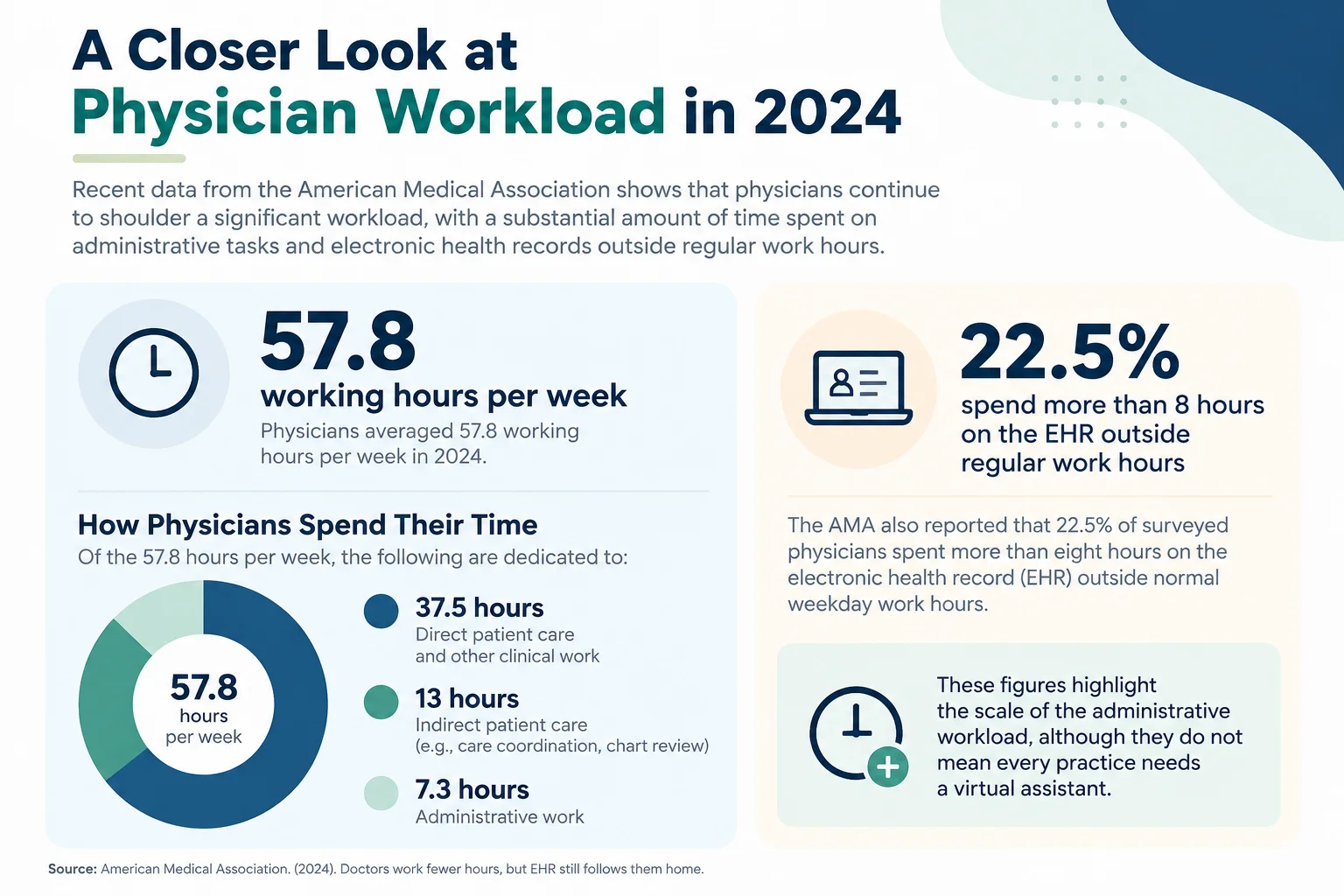
The best way to hire a medical virtual assistant is to define the administrative work that is slowing your practice down, specify the skills and safeguards the role requires, assess candidates using realistic tasks, and prepare onboarding before the person starts. The evidence makes a strong case for addressing administrative workload: the American Medical Association’s 2024 data put physicians’ average workweek at 57.8 hours, including 13 hours of indirect patient care and 7.3 hours of administrative work. A virtual assistant will not solve every operational problem, but a carefully scoped role can help practices reclaim capacity from repeatable administrative tasks. [1]
Key Takeaways
- Do not hire a generic assistant and expect them to figure out healthcare operations. Define the work, risk, and outcomes first.
- Research from the AMA shows that administrative and indirect patient-care work takes a substantial share of physicians’ time; delegation should target the right tasks, not clinical accountability.
- Prioritize medical virtual assistant qualifications that match the scope: healthcare administration experience, accuracy, communication, software adaptability, confidentiality, and escalation judgment.
- Use structured interviews, consistent scorecards, and fictional work samples instead of hiring on personality or résumé claims alone.
- Compare medical virtual assistant cost against the full operating model: training, supervision, coverage, quality controls, and the cost of mistakes.
- Evidence supports appointment reminders as a way to improve attendance, but results depend on process design; an assistant should support a reliable workflow, not merely send messages.
- Remote Raven recommends a measured approach: start with a defined task set, monitor quality, and expand responsibilities only when the process is working.
Introduction
Healthcare practices are not short of work. They are often short of uninterrupted time to do the work that matters most. Appointment scheduling, intake follow-ups, records organization, inbox coordination, referral administration, and billing-related follow-up can compete with patient-facing responsibilities. When these workflows are fragmented, staff spend time chasing information, correcting errors, and passing tasks between people.
This is not just a matter of convenience. The American Medical Association’s summary of 2024 physician work data reports that physicians averaged 57.8 working hours per week, including 13 hours of indirect patient care and 7.3 hours of administrative work. The AMA also reported that 22.5% of surveyed physicians spent more than eight hours on the electronic health record outside normal weekday work hours. These figures highlight the scale of the administrative workload, although they do not mean every practice needs a virtual assistant. Source: American Medical Association.
For healthcare practices considering how to address this workload, Remote Raven helps businesses explore remote staffing and virtual assistant support as part of a more structured approach to administrative work. The starting point is identifying which tasks can be delegated, what experience those tasks require, and how the work should be managed without compromising patient privacy, service quality, or clinical accountability.
A medical virtual assistant (MVA) is a remote professional who handles defined, non-clinical administrative workflows for a healthcare practice. A healthcare virtual assistant is the broader category; a medical virtual assistant is typically expected to understand healthcare-specific workflows, confidentiality requirements, and escalation boundaries. Neither title authorizes the person to make clinical decisions.
What the research suggests
- Physician workload: AMA data indicate that indirect patient care and administrative work occupy a meaningful part of the physician workweek. This supports auditing administrative tasks before deciding what to delegate.
- Hiring pressure: an MGMA poll found that 53% of 427 responding medical group leaders identified finding candidates as their top staffing challenge. Clear role design can help practices evaluate candidates against real needs rather than vague job descriptions.[2]
- Appointment reminders: a BMJ Open review found higher attendance in studies using text reminders than in comparison groups. Reminders are a promising workflow tool, but results depend on patient population, process design, and implementation.[3]
- Privacy and security: HHS guidance highlights the importance of policies, authentication, technology safeguards, and workforce training. Practices should apply the requirements relevant to their own jurisdiction and arrangements.[4]
Hiring a medical virtual assistant should be treated as an operations decision, not a quick fix for an overloaded front desk. If the practice has unclear processes, inconsistent ownership, or no quality checks, adding a remote worker may simply move the confusion to another person. Remote Raven recommends defining the workflow first, then hiring against that definition. This is also why reducing healthcare administrative burden requires workflow design and clear handoffs, not just adding another person. See how virtual support can help reduce administrative pressure on healthcare staff.
This guide explains how to hire a virtual medical assistant with that mindset. It combines practical hiring advice with published research and official guidance. Research findings are identified as such; recommendations are clearly presented as operational judgment rather than as proven outcomes for every practice.
What is the best way to hire a medical virtual assistant?
The best way to hire a medical virtual assistant is to map the tasks, define clear boundaries, assess candidates against those tasks, confirm privacy and security requirements, and onboard the person in stages. Remote Raven’s position is simple: the job description should be built from the work—not copied from a generic template.
Follow this sequence:
- Audit the workload. List recurring tasks, frequency, time required, bottlenecks, and the people currently responsible.
- Separate administrative work from clinical judgment. Document which tasks can be completed using approved procedures and which must be escalated to a qualified clinician or designated employee.
- Define success. Set realistic measures such as turnaround time, completeness, response routing, and error rate.
- Screen consistently. Ask candidates the same core questions and score them against pre-agreed criteria.
- Use realistic, fictional work samples. Test prioritization, accuracy, written communication, and escalation judgment without exposing real patient information.
- Prepare onboarding and controls. Set up approved access, standard operating procedures, communication channels, and a review cadence before the first working day.
There is a reason to take role definition seriously. In an October 2024 MGMA Stat poll, 53% of 427 responding medical group leaders identified finding candidates as their top staffing challenge, ahead of compensation and benefits (29%) and retention (16%). The poll does not prove that virtual staffing is the answer, but it does show why practices should avoid wasting scarce hiring time on vague roles and mismatched candidates. [2] Source [2]

Rather than starting with “We need a medical VA,” start with “Here are the 10–15 tasks that are creating the most friction, and here is how we will know they are being handled well.” This follows the same principle used in a structured remote staffing process: define the problem and responsibilities before sourcing candidates.
Define the Role Before You Start Hiring
A virtual assistant for medical practice support may handle scheduling, approved patient communications, intake coordination, records organization, referral follow-up, calendar support, or billing administration. The right scope depends on the practice’s workflows, systems, patient population, and applicable legal and contractual obligations. The scope should reflect how medical virtual assistants support modern healthcare workflows—especially scheduling, intake, communication, and follow-up.
Avoid a job description that says the assistant will “manage everything.” That phrase is not flexibility; it is a warning sign. It hides workload, makes performance hard to measure, and can blur the line between administrative coordination and clinical decision-making. Start with repeatable work that has clear instructions and a known owner. For each task, define the trigger, steps, expected output, deadline, system of record, and escalation path.
|
Task Area |
Example Medical Virtual Assistant Duties |
Possible Measure |
|
Scheduling |
Appointment reminders, calen dar updates, rescheduling requests |
Requests handled within target time; scheduling error rate |
|
Patient communication |
Approved phone, email, or portal workflows; routing messages |
Response time; correct routing; documented handoffs |
|
Intake coordination |
Tracking forms, checking completeness, following up on missing items |
Completeness before appointment or deadline |
|
Records administration |
Organizing documents and updating approved fields |
Accuracy; incomplete records; rework rate |
|
Billing administration |
Claim-status follow-up, payment reminders, data entry support |
Follow-ups completed; exceptions escalated |
|
Practice coordination |
Inbox sorting, task tracking, provider calendar support |
Backlog; overdue tasks; handoff quality |
The Delegation Readiness Test: Three Conditions
A task is ready to delegate when it passes three tests: repeatability, bounded authority, and measurability. These conditions help distinguish work that can be transferred safely from work that still depends on undocumented judgment.
- Repeatability: the task occurs often enough to justify a documented workflow, and the steps are broadly consistent.
- Bounded authority: the assistant can complete the task without making clinical decisions or exercising authority that has not been explicitly assigned.
- Measurability: the practice can define a satisfactory output and check it through a practical measure such as completeness, turnaround time, error rate, or successful handoff.
Example: appointment reminders usually pass the test when approved scripts, contact rules, response routing, and documentation standards are in place. Responding to a patient’s new clinical symptom does not pass the same test unless the assistant is only routing the message under an approved protocol.
Appointment reminders are a useful example of why operational detail matters. A systematic review and meta-analysis published in BMJ Open included 26 studies; its primary analysis included 21 studies with 8,345 patients receiving text notifications and 7,731 receiving no notifications. Patients who received electronic text reminders were more likely to attend (67% versus 54%) and less likely to miss appointments (15% versus 21%). The review found multiple notifications were more effective than a single notification. These results support reminders as a useful workflow, but they do not mean a virtual assistant alone will reproduce the same effect in every practice. Patient populations, reminder methods, scheduling processes, and study settings vary. [3]
Appointment reminders should be designed as a complete process: confirm the right contact details, use approved wording and channels, document responses, route cancellation requests, and make it possible to refill released appointment slots. A reminder sent without a way to process the reply is an incomplete workflow. A consistent approach to scheduling, patient communication, and follow-up is one way virtual medical assistants can support the patient experience.
Once the task list is clear, prioritize by frequency, time consumed, operational risk, and how easily the task can be documented. Begin with a manageable scope and use a baseline to assess whether performance improves.
What Are The Medical Virtual Assistant Qualifications to Prioritize?
The most important medical virtual assistant qualifications are those that fit the work: relevant healthcare administration experience, accurate execution, clear communication, software adaptability, confidentiality, and the judgment to escalate instead of guessing. The more sensitive or complex the task, the more important relevant experience and supervision become.
Do not confuse polished interview answers with operational competence. A candidate may sound confident but still struggle to prioritize a busy inbox, document a handoff, or recognize when a request falls outside their authority. Remote Raven recommends evaluating evidence of working habits, not confidence alone.
|
Qualification |
Evidence to Look For |
Interview Prompt |
|
Healthcare administration |
Relevant work with clinics, scheduling, patient coordination, or records |
“Which workflows have you supported, and what exactly did you own?” |
|
Communication |
Clear, professional writing and calm verbal communication |
“How would you respond to a patient question you are not authorized to answer?” |
|
Accuracy |
Checklists, careful data entry, and reliable follow-through |
“What do you do to catch errors in repetitive tasks?” |
|
Software adaptability |
Ability to learn scheduling, EHR/EMR, phone, or task tools |
“Describe a system you learned quickly and how you validated your work.” |
|
Privacy and security mindset |
Understands approved channels, least-necessary access, and incident reporting |
“What would you do if someone asked you to send patient information through an unapproved channel?” |
|
Remote-work discipline |
Clear status updates, documented handoffs, reliable availability |
“How do you communicate when a task is blocked or a deadline is at risk?” |
The U.S. Department of Health and Human Services’ Telehealth.HHS.gov guidance emphasizes policies, authentication, technology security, and training when protecting health information in telehealth workflows. While a medical virtual assistant arrangement is not identical to telehealth delivery, the same operational lesson applies: secure tools alone are not enough if people lack training or clear procedures. Practices should apply the rules that actually govern their organization and arrangement, rather than assume that one checklist guarantees compliance. [4] For the official principles, see HHS privacy and security guidance.
For specialized tasks such as medical coding, billing, or other regulated work, verify the specific knowledge and qualifications required. General administrative experience is not a substitute for specialized competence. Check references and follow your normal hiring process. Practices comparing medical virtual assistant services should match the candidate’s experience to the precise duties, rather than treating all healthcare support roles as interchangeable.
One qualification deserves special emphasis: knowing when to stop. An assistant should route clinical questions, urgent concerns, unclear instructions, and suspected privacy incidents through the practice’s designated escalation process. In healthcare, “I will check with the appropriate person” is often a stronger answer than an unsupported guess.
Build a Practical Screening and Interview Process
A good screening process tests how a candidate would work, not just how well they interview. Use the same core questions and a consistent scorecard for each candidate. Then add a short, fictional work sample that reflects the actual role. Do not use real patient information in recruitment exercises.
For example, provide a fictional schedule with a cancellation, a routine appointment request, an incomplete intake form, and a message that needs clinician review. Ask the candidate to prioritize the tasks, explain what they would document, and identify what must be escalated. This tests organization and judgment without asking the candidate to make a clinical decision.
Candidate Scorecard
|
Evaluation Area |
1 — Weak Fit |
3 — Acceptable Fit |
5 — Strong Fit |
|
Role match |
Little relevant experience |
Related administrative experience |
Direct experience with comparable workflows |
|
Communication |
Unclear or inconsistent |
Generally professional |
Clear, accurate, and appropriate |
|
Accuracy |
Misses details |
Careful with routine checks |
Uses a repeatable checking method |
|
Workflow judgment |
Guesses or misses priorities |
Handles routine work with guidance |
Prioritizes, documents, and escalates appropriately |
|
Security mindset |
Cannot explain safe handling |
Understands basic expectations |
Follows controls and raises concerns |
|
Training readiness |
Resists feedback or documentation |
Willing to learn |
Applies feedback and documents processes |
Agree on the scoring criteria before interviewing. Take notes, compare candidates against the same standard, and consider work samples and references alongside interview performance. Do not allow a high average score to cancel out a serious concern about confidentiality, reliability, or role boundaries.
A structured hiring process is not bureaucracy for its own sake. It protects the practice from making a high-stakes staffing decision based on likability, urgency, or one impressive interview. It also makes training needs visible before the hire begins.
How to interpret the scorecard: treat critical safeguards as pass/fail gates, not just weighted scores. A candidate who communicates well but cannot demonstrate confidentiality awareness or appropriate escalation judgment should not advance simply because their average score is high. Skills gaps that can be trained—such as learning a scheduling platform—can be weighed differently from gaps that create immediate operational risk.
Understand Medical Virtual Assistant Cost Without Chasing the Cheapest Option
Medical virtual assistant cost depends on experience, location, hours, task complexity, hiring model, coverage needs, and the support included. There is no single rate that fits every practice. Remote Raven helps businesses explore remote staffing and virtual assistant support based on their operational needs. Before making a decision, practices should request a clear breakdown of costs and compare providers against the same task scope, working hours, and level of support.
The cheapest option is not automatically the most economical. If a low-cost arrangement requires extensive supervision, repeated corrections, missed handoffs, or retraining, its apparent savings may disappear. Equally, a higher price is not proof of better quality. Practices should evaluate the full operating model, assess how the assistant will be managed, and clarify exactly what the fee includes before committing.
Include these factors in your comparison:
- Expected hours and the volume of work available.
- Experience required for each task and the complexity of the workflow.
- Recruitment, training, management, supervision, and quality-review time.
- Coverage, time-zone overlap, backup arrangements, and handoffs.
- Software, access controls, communication tools, and security requirements.
- The potential cost of errors, rework, missed follow-ups, or delayed patient communication.
|
Question to Ask |
Why It Matters |
|
What tasks are included in the scope? |
Prevents a mismatch between expectations and the actual service. |
|
Who supervises work and reviews quality? |
Clarifies accountability when errors or exceptions occur. |
|
What screening and onboarding are included? |
Shows whether the provider supports a repeatable hiring process. |
|
What are the coverage and replacement arrangements? |
Helps assess continuity if availability changes. |
|
What security and contractual obligations apply? |
Ensures the practice evaluates controls before access is granted. |
A generalist may be appropriate for well-defined scheduling and administrative tasks. More specialized work may justify a candidate with relevant healthcare experience and stronger review procedures. The right decision depends on risk and workload—not the label “medical VA.” Remote Raven recommends defining the scope first and then comparing medical virtual assistant services against the same outcomes.
Be careful with return-on-investment claims. Unless you have reliable baseline data, do not assume that hiring an assistant will automatically reduce costs by a specific percentage or improve revenue by a guaranteed amount. Measure your own workflow before and after implementation.
Plan Medical Virtual Assistant Onboarding Before Day One
Medical virtual assistant onboarding should begin before the assistant’s first day. The practice should document responsibilities, approved system access, standard operating procedures, communication rules, escalation paths, and quality measures. Remote Raven recommends a staged transfer of responsibility—not handing over a password and hoping the person learns by osmosis.
|
Stage |
Practice Actions |
Evidence of Readiness |
|
Before day one |
Confirm scope, approved accounts, permissions, procedures, and communication channels |
Assistant understands boundaries and has only necessary access |
|
Week 1 |
Demonstrate workflows; use approved training examples; review work closely |
Assistant can explain steps and ask for clarification |
|
Weeks 2–4 |
Assign routine tasks gradually; sample work; give documented feedback |
Quality and consistency are visible |
|
30-day review |
Review outcomes, workload, handoffs, and training needs |
Responsibilities reflect demonstrated performance |
|
Ongoing |
Refresh procedures, review access, hold check-ins, and document changes |
Accountability remains clear as the role evolves |
Onboarding Checklist
- Share the role description, priorities, working hours, and definition of completed work.
- Provide only approved access to the systems and records needed for the role.
- Explain applicable confidentiality, privacy, security, and communication requirements.
- Document standard operating procedures for recurring tasks.
- Define escalation steps for urgent, unclear, clinical, or sensitive issues.
- Use fictional or approved training cases before live work.
- Set quality measures for accuracy, turnaround time, completion, and handoffs.
- Schedule check-ins and review access when responsibilities change.
HHS guidance identifies staff training, authentication, technology security, and clear policies as important parts of protecting health information. The practical implication is straightforward: onboarding should include security behaviour and decision boundaries, not just software training. Applicable obligations differ by jurisdiction and contract, so practices should confirm their specific requirements with qualified compliance or legal advisers. [4] The underlying HHS guidance on privacy and security reinforces why onboarding should include secure work practices, not just software training.
Write procedures in plain language. For each task, show who owns it, where status is recorded, what to do when information is missing, and who makes the decision when an exception arises. A remote assistant cannot learn from informal office conversations they are not present for; documented workflows close that gap. For remote hires, a structured 30-60-90-day onboarding plan helps turn those procedures into staged expectations and measurable check-ins.
How Remote Raven Can Help You Hire Your First Medical Virtual Assistant
Remote Raven helps businesses explore remote staffing and virtual assistant support by starting with the work that needs to be done. For a healthcare practice, that means clarifying which administrative tasks are suitable for delegation, what experience the role requires, and how the assistant should work with the existing team. The aim is to make hiring a considered operational decision rather than a rushed response to an overloaded front desk. Its approach is strongest when the practice first maps the tasks and measures that matter, then aligns the role to them—a principle also reflected in effective medical virtual assistant support.
Before discussing medical virtual assistant services, prepare to explain:
- Which recurring tasks create the most administrative friction.
- Which systems, working hours, and communication channels the role would use.
- What experience and qualifications each task requires.
- What privacy, access, documentation, and escalation controls the practice expects.
- How performance will be assessed during the first 30–90 days.
The strongest staffing decisions begin with a well-defined scope. A healthcare virtual assistant is not a replacement for clinicians, a cure for broken processes, or a reason to grant unrestricted access to patient information. The role works best when responsibilities are clear, processes are documented, and the practice retains appropriate oversight. That matters because administrative delegation works best when recurring tasks and handoffs are clearly defined.
Ready to explore hiring your first medical virtual assistant? Book a free 30-minute consultation with Remote Raven to discuss your administrative priorities, role requirements, and next steps. Use Remote Raven’s current booking option on the website to confirm the consultation details.
Final Takeaway
Learning how to hire a virtual medical assistant starts with defining the work—not searching for a candidate first. Published research documents a meaningful administrative workload for physicians and supports appointment reminders as one practical tool for improving attendance. It does not prove that every practice needs a virtual assistant or that hiring one guarantees a specific financial return. The business case has to be tested against your own workflow.
Define the tasks, establish boundaries, assess candidates consistently, compare total cost and operating fit, and prepare onboarding before day one. The best hire is not necessarily the person who promises to do the most for the lowest price. It is the person whose skills match the work, follows documented procedures, and knows when to ask for guidance. Remote Raven recommends starting with a focused scope, measuring results, and expanding responsibilities only when quality controls support it.
Research and Further Reading
- [1] American Medical Association — Doctors work fewer hours, but the EHR still follows them home (2024 physician work data).
- [2] Medical Group Management Association — Reshaping your medical practice staffing strategies for 2025 (MGMA Stat poll, October 2024).
- [3] BMJ Open — Using digital notifications to improve attendance in clinic: systematic review and meta-analysis.
- [4] U.S. Department of Health and Human Services — Develop a privacy and security strategy for telehealth.
FAQ
What does a medical virtual assistant do?
A medical virtual assistant supports defined administrative tasks such as scheduling, approved patient communication, intake coordination, records organization, inbox management, and billing-related follow-up. Duties depend on the person’s qualifications, the practice’s processes, and the access authorized for the role. Clinical decisions should remain with appropriately qualified professionals.
How do I hire a virtual medical assistant for the first time?
List the tasks you want to delegate, define the expected outcomes, write a clear role profile, screen candidates consistently, use fictional work samples, check references, and prepare onboarding and access controls. Remote Raven recommends starting with a manageable scope rather than delegating every possible task immediately.
What medical virtual assistant qualifications should I look for?
Prioritize relevant healthcare administration experience, communication, accuracy, software adaptability, confidentiality awareness, and good escalation judgment. Verify specialized qualifications when the role includes coding, billing, or other work that requires specific expertise.
How much does a medical virtual assistant cost?
Cost varies with experience, location, hours, task complexity, hiring model, and included support. Compare the full operating model—including training, supervision, coverage, and quality controls—rather than hourly price alone. Ask for a clear breakdown based on your defined task list.
Can a medical virtual assistant access patient records?
Only when access is authorized, necessary for the role, and consistent with the practice’s applicable legal, contractual, and security requirements. Establish permissions, training, approved communication channels, and incident-reporting procedures before granting access.
Which tasks should I delegate first?
Start with recurring, documented administrative tasks such as appointment reminders, calendar coordination, intake follow-up, approved inbox sorting, or records organization. Choose work with clear instructions and measurable outputs, then expand the role after consistent performance.
How should medical virtual assistant onboarding work?
Provide a written role scope, approved system access, standard operating procedures, communication rules, escalation steps, and quality measures. Start with training examples and frequent reviews, then assign routine tasks gradually.
Is a healthcare virtual assistant right for every practice?
No. The model is more suitable when the practice has recurring administrative work, documented processes, and someone available to provide oversight. Resolve unclear ownership and workflow problems before assuming a new hire will fix them.
How can Remote Raven help?
Remote Raven can help you clarify administrative support needs, define the role and required qualifications, and explore remote staffing options. Book a free 30-minute consultation through Remote Raven’s website to discuss your priorities and next steps.