


Remote healthcare employment in 2027 should be understood as a redesign of healthcare work—not simply a shift from offices to home workspaces. AI, telehealth, and connected devices create opportunities to redistribute administrative work, support patients between visits, and reserve clinical expertise for decisions requiring it.
Building on Remote Raven’s emphasis on clearly scoped virtual roles, this article translates current evidence into workforce decisions for healthcare leaders. The 2027 outlook below is analysis, not a claim that future hiring outcomes are already known.
Key Takeaways
- Plan around workflows, not remote headcount. Identify the bottleneck, assign ownership, and measure whether work reaches completion.
- Separate clinical authority from administrative execution. Remote location does not change qualification, licensure, or supervision requirements.
- Treat AI as a workflow change. Define review responsibilities and exception handling before assuming productivity gains.
- Staff the work around telehealth. Scheduling, technical preparation, records, and follow-up deserve explicit capacity.
- Evaluate the total operating value. Include technology, management, security, training, and rework—not just compensation.
- At Remote Raven, we believe the strongest healthcare workforce strategies combine clearly defined responsibilities, reliable virtual talent, and operational systems that protect patient experience while helping teams work more efficiently.
What Is Driving Remote Healthcare Employment in 2027?
The strongest drivers are continuing healthcare workforce demand, established virtual-care utilization, and expanding use of digital tools. Together, they support an operating model in which suitable work can be assigned beyond a facility’s walls. They do not establish that every healthcare occupation will become remote, or that virtual vacancies will grow at the same rate as healthcare employment overall. (bls.gov)
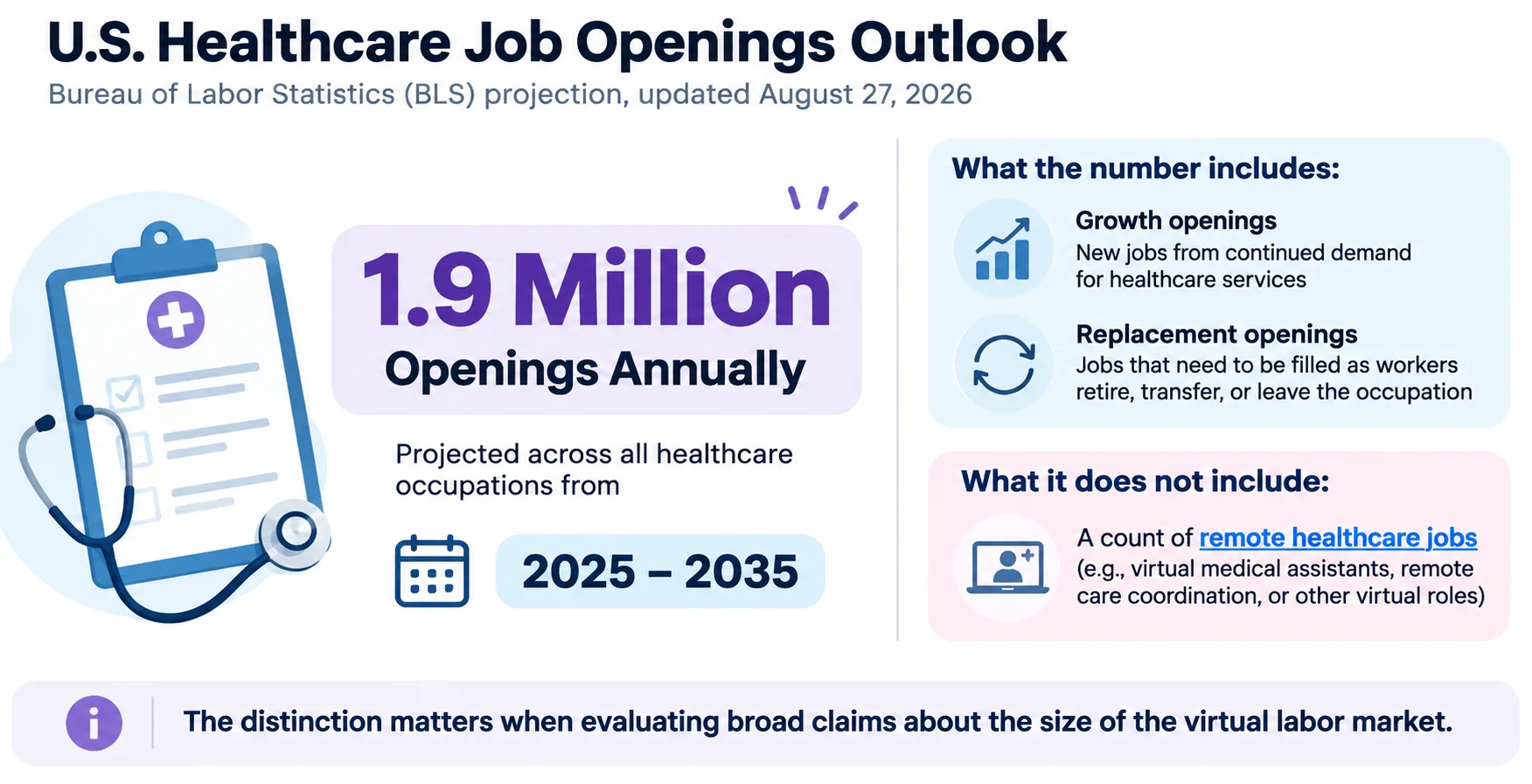
The Bureau of Labor Statistics’ healthcare occupations overview, updated August 27, 2026, projects approximately 1.9 million openings annually across 2025–2035. These include growth and replacement openings across healthcare occupations, not a count of remote healthcare jobs. The distinction matters when evaluating broad claims about the size of the virtual labor market. (bls.gov)
CMS’s Medicare Telehealth Trends report, released in September 2025, reports that 25% of telehealth-eligible Medicare fee-for-service users received a telehealth service in 2024. That population-specific measure supports treating telehealth as an established delivery channel, not assuming universal patient adoption or uninterrupted growth. CMS also identifies its figures as preliminary. (data.cms.gov)
For an operations leader, the useful question is where these developments intersect with unfinished work. Consider a specialty practice with available appointments but a persistent referral backlog. Before recruiting another clinician, investigate whether missing records, incomplete authorization submissions, or unreturned calls are preventing existing capacity from being used.
A practical assessment should distinguish three situations:
- Capacity shortage: The right person owns the work but cannot complete the incoming volume.
- Process failure: Responsibility, instructions, or handoffs are unclear.
- Capability gap: The work requires expertise the current team does not possess.
Recommend remote staffing only after identifying which problem exists. Adding people to an unclear process may increase coordination demands without resolving the original delay.
The strategic interpretation of remote healthcare employment trends is therefore selective expansion. Build roles around work that can be performed securely, evaluated consistently, and escalated appropriately. Keep physical procedures, examinations, and other location-dependent responsibilities within the necessary care setting.
AI Changes Task Ownership Before It Changes Job Titles
AI should first change how leaders allocate, review, and govern tasks—not trigger an automatic reduction in staffing assumptions. The relevant employment question is which responsibilities become easier to execute and which require more verification, judgment, or patient explanation.
In results published March 12, 2026, the American Medical Association reported that 81% of surveyed physicians used AI professionally. Professional use includes activities such as research summaries and documentation; it should not be interpreted as autonomous care delivery or equivalent adoption across every healthcare employer. (ama-assn.org)
For 2027 Planning: Distinguish Three Layers of Work
|
Work layer |
Suggested AI contribution |
Human responsibility |
|
Preparation |
Drafting an administrative response or organizing information |
Confirming source information and permitted use |
|
Verification |
Flagging missing fields or possible inconsistencies |
Resolving discrepancies and approving corrections |
|
Decisions and exceptions |
Supporting information retrieval |
Making authorized decisions and handling ambiguity |
Treat this as a role-design framework, not evidence that a particular tool can safely perform every listed activity. Test the actual product against the actual workflow before deployment.
For example, an authorization specialist’s role could shift from repeatedly assembling standard information toward checking completeness, investigating exceptions, and coordinating qualified review. The job description should explain who verifies generated content, who approves submissions, and what happens when the output conflicts with the record.
Do not measure success by drafts produced. Measure completed, accurate work after review. A faster first draft offers little operational value if the correction process consumes the time saved.
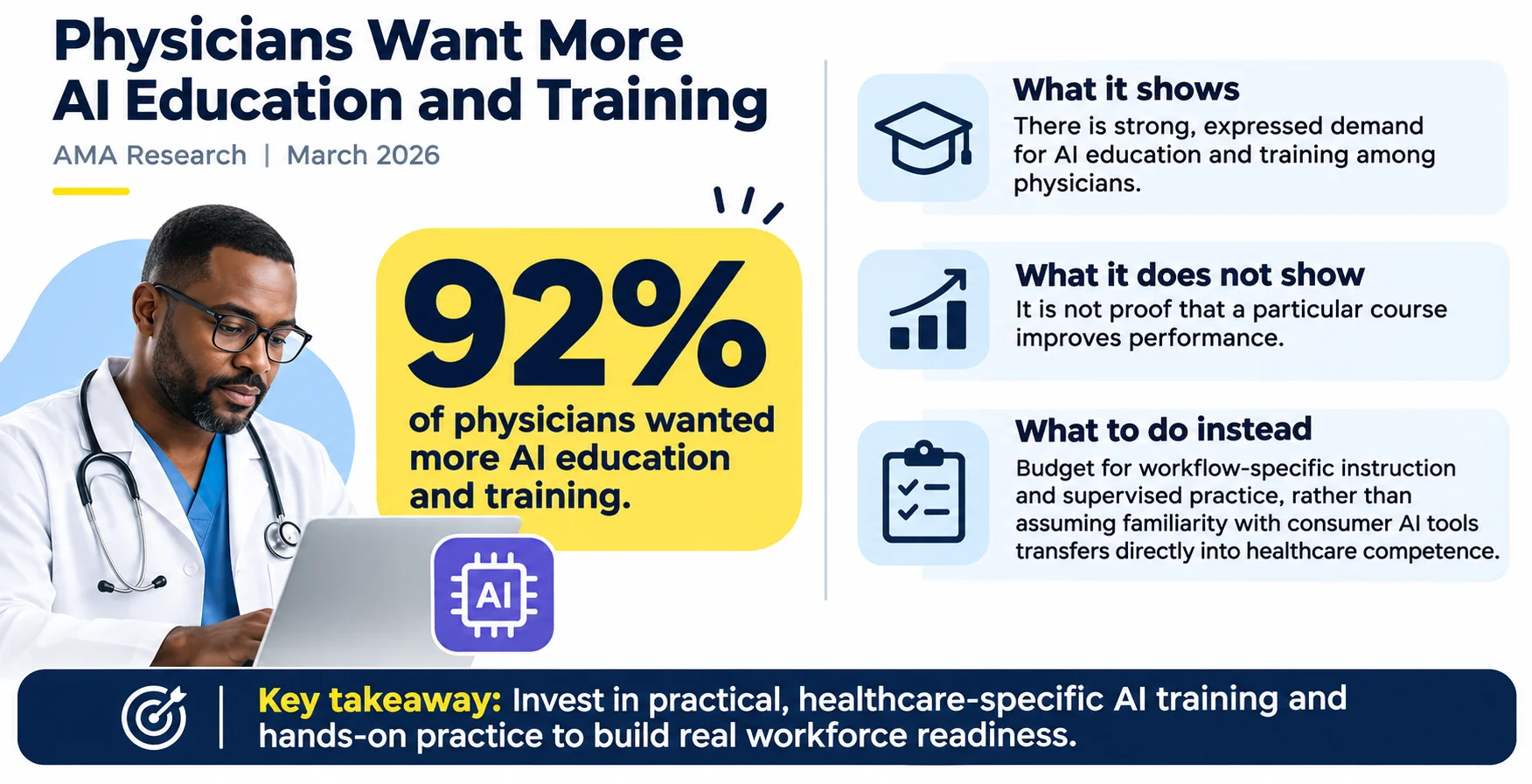
The AMA’s March 2026 research also found that 92% of physicians wanted more AI education and training. This is evidence of expressed training demand, not proof that a particular course improves performance. Budget for workflow-specific instruction and supervised practice rather than assuming familiarity with consumer AI tools transfers directly into healthcare competence. (ama-assn.org)
For Remote Raven’s virtual staffing perspective, the implication is straightforward: recruit for accountable tool use. Assess whether candidates can recognize uncertainty, verify information, and stop when a task exceeds their authority. Avoid treating prompt-writing fluency as a substitute for healthcare process knowledge.
At Remote Raven, we believe AI should strengthen remote professionals—not replace accountability. The value comes from people who use tools carefully, verify information, and understand when a task must be escalated.
Telehealth and Connected Devices Create Work Between Visits
Virtual-care workforce planning should account for the patient’s journey before, during, and after a consultation. Remote patient monitoring adds another layer: collecting information between encounters and routing it into an actionable care process. HHS guidance explicitly identifies enrollment, monitoring, technical support, education, and after-hours coverage as staffing considerations. (telehealth.hhs.gov)
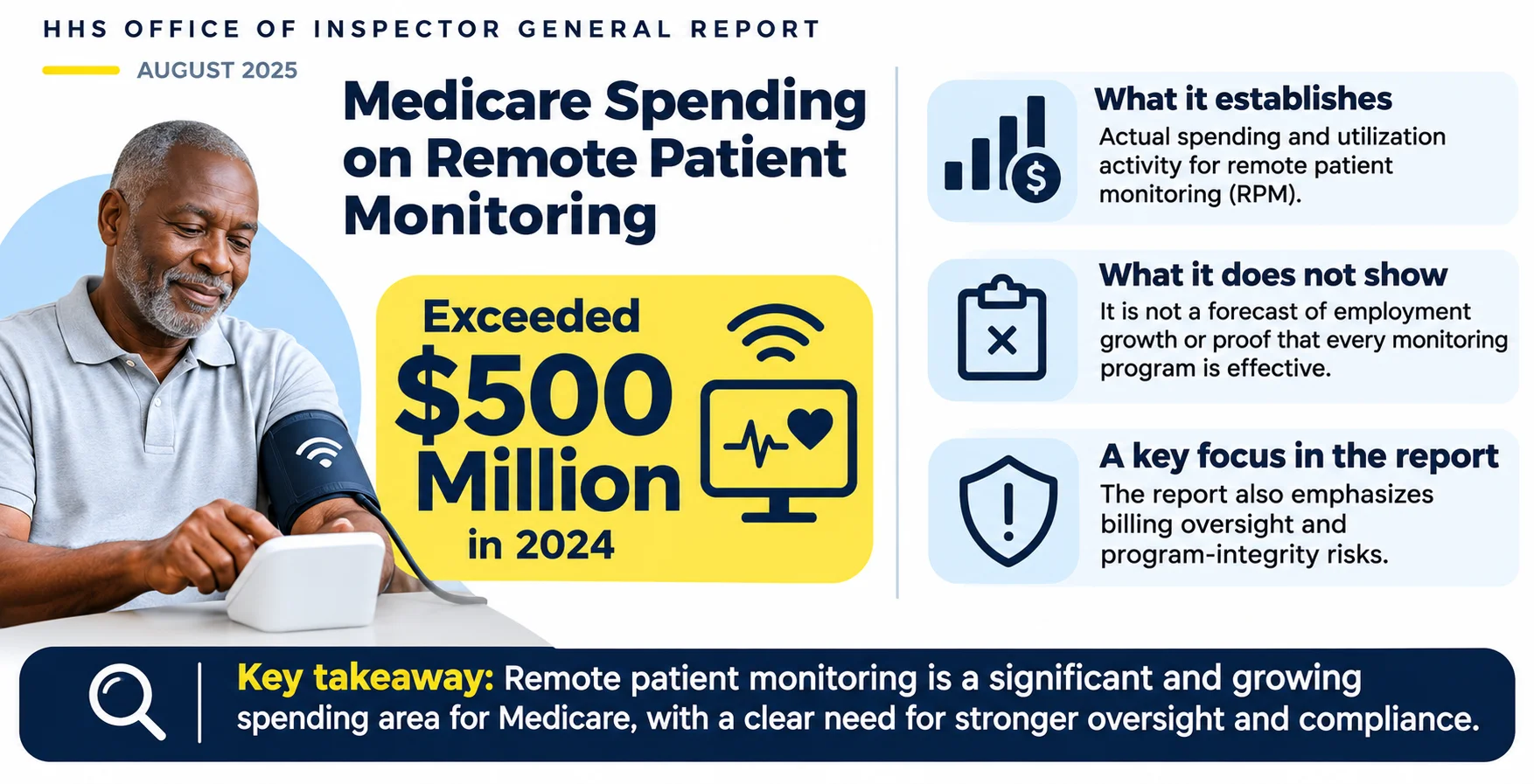
Observed spending: HHS’s Office of Inspector General reported in August 2025 that Medicare payments for remote patient monitoring exceeded $500 million in 2024. This establishes spending and utilization activity, not a forecast of employment growth or proof that every monitoring program is effective. The same report emphasizes billing oversight and program-integrity risks. (oig.hhs.gov)
Connected blood pressure cuffs, scales, glucose technology, and some wearables can help transmit information from home. However, collecting information is only one part of the service; patients also need instructions, communication, and a clear understanding of what happens when readings require attention. (telehealth.hhs.gov)
Consider this illustrative workflow:
- Prepare the patient: Confirm contact details, explain setup, and establish approved communication channels.
- Support participation: Troubleshoot transmission problems and follow up on missing information within an authorized administrative scope.
- Route concerns: Send readings or reported symptoms to qualified clinical staff according to approved protocols.
- Close the loop: Record the action, confirm ownership, and arrange the next step.
Keep technical assistance separate from clinical interpretation. Someone helping a patient reconnect a device should not independently decide whether a concerning reading can wait. Establish coverage expectations and escalation routes before enrollment begins.
For a nurse considering a move from hospital shifts into monitoring, assess the whole job rather than its remote label. Ask about patient acuity, alert volume, response expectations, clinical backup, and scheduled coverage. For an employer, use those same factors to determine staffing needs instead of assigning a uniform patient panel without examining workload.
The planning principle is simple: every additional data stream needs an owner, a response process, and a defined endpoint. Do not launch a monitoring service with an enrollment target but no operating plan for incoming work.
Which Remote Healthcare Jobs Deserve Workforce Planning Attention?
Healthcare leaders should examine patient access, revenue-cycle support, care coordination, licensed virtual care, and digital workflow operations. These are useful role families for planning, but available evidence does not justify ranking them as the fastest-growing remote occupations nationally. Occupational growth figures and remote-specific vacancy counts measure different things.
BLS’s medical and health services managers profile, updated August 27, 2026, projects 24% employment growth from 2025 to 2035. This supports attention to healthcare coordination and management’s capacity, but it includes on-site and other working arrangements—not just virtual operations roles. (bls.gov)
Use the following role map to build a more precise hiring discussion:
|
Role family |
Example titles |
Work to evaluate for remote delivery |
Boundary to define |
|
Patient access |
Medical scheduler, patient representative |
Bookings, reminders, intake coordination |
Clinical urgency decisions |
|
Revenue cycle |
Billing coordinator, authorization specialist |
Documentation tracking, payer follow-up |
Coding expertise and clinical justification |
|
Administrative coordination |
Virtual medical assistant, referral coordinator |
Records requests, referral tracking, message routing |
Independent medical advice |
|
Licensed virtual care |
Telehealth clinician, remote monitoring nurse |
Appropriate consultations, assessment, monitoring |
Licensure, scope, clinical supervision |
|
Digital operations |
EHR support specialist, workflow analyst |
User support, reporting, workflow testing |
System permissions and change approval |
These examples are a planning taxonomy, not a statement that each title is currently available in every market. Define the responsibilities before selecting the title, then verify qualifications against the actual work.
Compensation and geographic flexibility
The same BLS profile reports a $123,860 median annual wage in May 2025 for medical and health services managers. Published in the profile updated August 27, 2026, this is an occupation-wide benchmark—not a remote salary, an entry-level offer, or an appropriate rate for a virtual assistant. (bls.gov)
Build compensation comparisons around equivalent responsibilities, experience, credentials, schedules, and employment arrangements. Avoid comparing a specialist clinical position with an administrative support role simply because both are remote.
Similarly, specify permitted work locations rather than advertising “work from anywhere.” HHS explains that interstate clinical practice depends on applicable state requirements and available pathways, such as full licenses, compacts, or telehealth registration. Remote work does not remove those conditions. (telehealth.hhs.gov)
Virtual Talent Works Best Within a Deliberate Operating Model
Build a virtual team around a clearly defined service—not a catch-all list of tasks others avoid. Give the role a purpose, supervisor, manageable scope, and a clear definition of “done,” aligning with Remote Raven’s guidance to establish task ownership before recruiting healthcare support. (hireremoteraven.com)
Instead of vague requests like “help with referrals,” write an operating specification (e.g., manage the referral queue, request missing docs, update status in approved systems, and escalate clinical questions). This clarity makes training, access, and performance reviews easier.
Use a five-part role charter:
- Outcome: the result (e.g., every referral reaches a documented disposition)
- Inputs: systems and requests received
- Authority: actions allowed vs. approvals needed
- Handoffs: receiving team and acknowledgment requirements
- Coverage: hours, backup, and unresolved-work procedures
Then choose the right staffing arrangement: redeploy internally when domain knowledge matters, pursue external recruitment for missing capabilities, or use a staffing partner when sourcing, screening, or ongoing support is required—evaluating each option against the same requirements.
Keep management ownership in the operating plan, including time for a point person. Use Remote Raven’s resource on virtual medical assistant roles and responsibilities to separate admin from clinical work, and intentionally design how remote and on-site teams coordinate so ownership stays visible and requests remain traceable.
Security, Licensure, and Patient Trust Set the Boundaries
Set legal, privacy, and clinical boundaries before granting access or assigning patient-facing responsibilities. Have qualified compliance and clinical leaders review the proposed arrangement, including work locations, information flows, supervision, and relevant contractual requirements. This article offers planning considerations, not a determination that any staffing model is compliant.
HHS advises providers to verify patient location and obtain consent before an appointment, while recognizing that cross-state practice requirements vary. Build those checks into scheduling and encounter preparation rather than relying on clinicians to discover problems after a visit begins. (telehealth.hhs.gov)
For information security, evaluate the complete arrangement. HHS cloud-computing guidance explains that covered entities and business associates must assess relevant risks and establish appropriate business associate agreements when applicable. A vendor’s marketing description does not replace the organization’s own risk analysis. (hhs.gov)
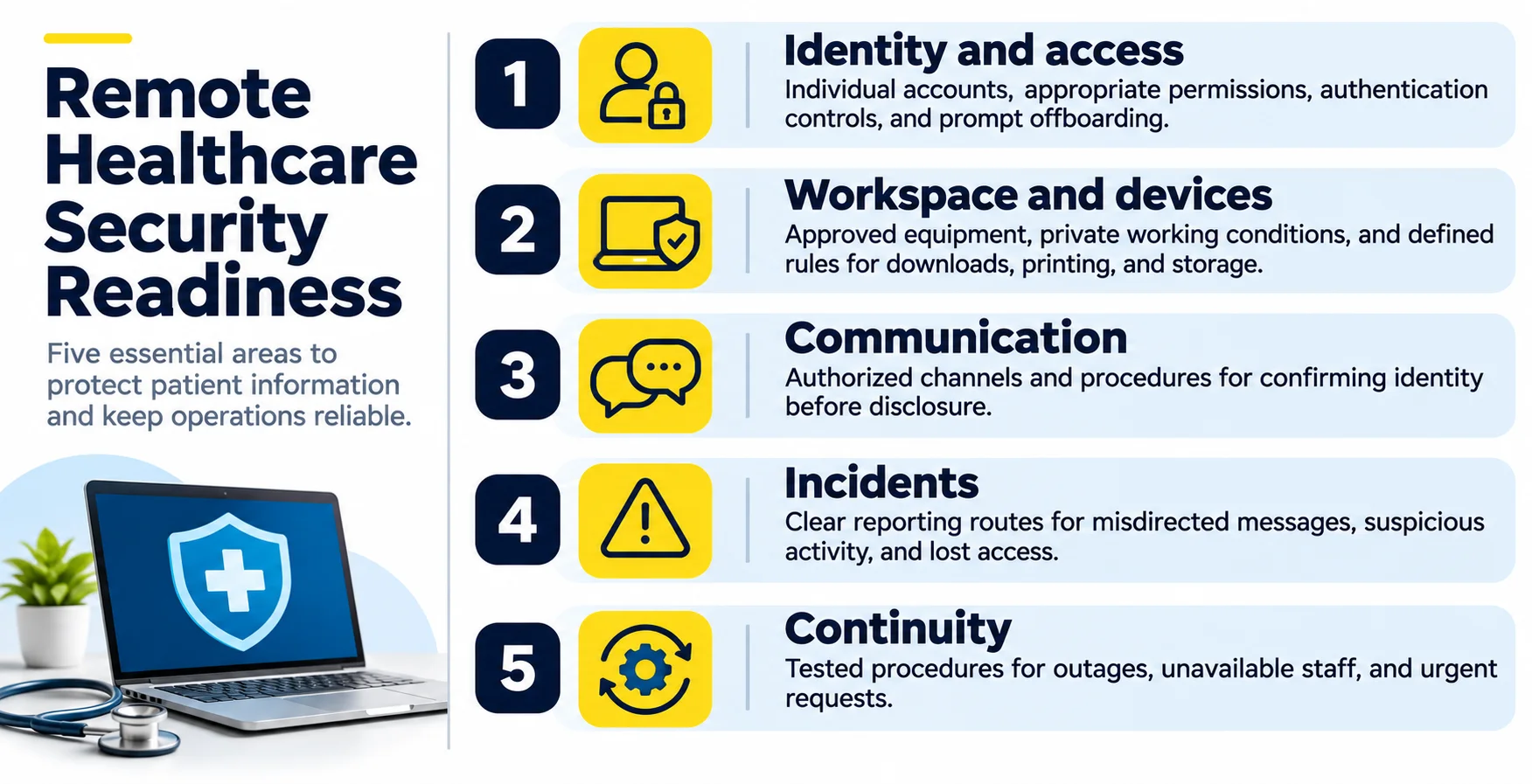
Use a readiness review covering:
- Identity and access: Individual accounts, appropriate permissions, authentication controls, and prompt offboarding.
- Workspace and devices: Approved equipment, private working conditions, and defined rules for downloads, printing, and storage.
- Communication: Authorized channels and procedures for confirming identity before disclosure.
- Incidents: Clear reporting routes for misdirected messages, suspicious activity, and lost access.
- Continuity: Tested procedures for outages, unavailable staff, and urgent requests.
Treat these review categories to validate security specialists, not a complete compliance checklist. NIST’s HIPAA Security Rule resource guide specifically includes teleworkers and external service providers within remote-access risk considerations. (nvlpubs.nist.gov)
Survey finding: In the AMA’s March 2026 research, 41% of physician respondents expected AI to harm patient privacy. That measures concern, not an observed breach rate, but it reinforces the need to make approved AI use explicit. Specify which tools may receive which information and who authorizes exceptions. (ama-assn.org)
For further implementation context, consult Remote Raven’s guidance on HIPAA compliance in remote healthcare staffing, alongside authoritative requirements and organization-specific advice.
Upskilling Should Demonstrate Safe Performance
Evaluate remote readiness through supervised task performance rather than course completion alone. A certificate may support development, but the hiring decision should reflect the candidate’s ability to execute the assigned workflow accurately, communicate clearly, and recognize when help is necessary.
Organize Training Around Four Capabilities
- Workflow fluency: Navigate approved systems, document actions, and maintain an understandable task history.
- Patient communication: Explain the next step in plain language and confirm understanding without exceeding the role’s authority.
- AI judgment: Check generated content against approved sources and identify unsupported or inappropriate output.
- Escalation discipline: Recognize exceptions, contact the right person, and verify that responsibility has transferred.
Use realistic exercises without real patient information. Give a scheduling candidate an ambiguous request and assess whether they seek clarification. Ask a billing candidate to identify missing documentation. Have an experienced nurse explain how they would respond when monitoring information is incomplete, using your approved clinical framework.
For professionals pursuing healthcare work from home, start with a role-specific gap assessment. Review several relevant job descriptions, separate required credentials from preferred software experience, and identify recurring responsibilities. Then choose training that addresses those responsibilities rather than collecting unrelated credentials.
A clinician transitioning into remote monitoring should seek instruction in the employer’s platform, escalation protocols, documentation expectations, and remote communication practices. An administrative professional moving into patient access should prioritize medical terminology, scheduling rules, privacy procedures, and message routing. Where coding or another specialist credential is required, verify the employer’s accepted qualification before enrolling in a program.
Employers should also train supervisors. Require them to give clear written feedback, calibrate quality reviews, and distinguish a learning need from a broken process. Otherwise, workers may be assessed against inconsistent expectations despite completing formal onboarding.
Finally, make progression visible. Define what competent performance looks like at entry, independent practice, and specialist levels. Offer development through increased expertise and appropriate responsibility—not simply larger queues. Build retention into the workforce plan rather than treating replacement hiring as the default response to turnover.
Build the 2027 Workforce Plan Around Scenarios and Outcomes
Use a scenario-based plan to connect with demand, staffing, technology, and financial assumptions. Avoid forecasting remote headcounts from a single growth percentage. Instead, estimate the work your organization expects to receive and test how the operating model responds when assumptions change.
Start with three scenarios:
|
Scenario |
Planning assumption |
Management response |
|
Stable demand |
Similar volume and case complexity |
Improve completion and reduce avoidable handoffs |
|
Higher demand |
More visits, messages, referrals, or monitoring activity |
Expand the constrained capability with supervision capacity |
|
Disruption |
Outages, absences, payer changes, or workflow failures |
Activate backup coverage and prioritize essential services |
Estimate workload using local observations: incoming task volume, handling time, variation, rework, and required coverage. Include onboarding, meetings, leave, and quality review rather than treating every paid hour as available processing time. Label uncertain assumptions and revisit them after implementation.
For a limited pilot, select one workflow with a visible problem and a named owner. Record its starting performance, introduce the role, and compare results using consistent definitions. Include patient and staff feedback so that apparent efficiency does not conceal confusion or transferred work.
Track a Balanced Set of Measures
- Access: Time until a request receives meaningful action.
- Completion: Work reaching a defined endpoint, not merely being touched.
- Quality: Accuracy, rework, and sampled documentation findings.
- Experience: Patient understanding and staff-reported coordination problems.
- Economics: Total cost per completed unit of acceptable work.
Build the financial model from compensation or service fees plus technology, training, supervision, security, and rework. Compare it with the existing process on equivalent terms. Treat potential revenue gains as assumptions until observed, rather than counting every minute saved as additional billable care.
Before scaling, ask whether the result survives ordinary absences, peak demand, and supervisor unavailability. If performance depends on one exceptional worker or constant intervention, improve the process first. Expand only when responsibilities, controls, and outcomes are repeatable.
Remote Raven: Turning Workforce Strategy into Operational Support
Healthcare organizations considering remote staffing need clarity on which workflows can be handled remotely, what each role owns, how the team will be supervised, and how performance will be measured.
Remote Raven supports healthcare practices by aligning operational needs with properly scoped virtual talent for administrative workflows like patient coordination, scheduling, and documentation support, while keeping clinical decisions and regulated duties with qualified professionals. The process starts with a practical discussion of tasks, bottlenecks, skills, systems, and safeguards to assess fit before committing.
Book your free 30-minute consultation
Conclusion
The most useful 2027 strategy is not to maximize remote positions. It is to place suitable work with qualified people, support them with governed technology, and make completion measurable. Remote Raven’s emphasis on clearly defined virtual responsibilities offers a practical starting point: specify the work before selecting the staffing solution.
Choose one consequential bottleneck, establish its baseline, and test a bounded operating model. Let demonstrate quality, patient experience, and total cost—not enthusiasm for remote work or AI—determine the next investment.
Frequently Asked Questions About Implementation
Should a practice pilot remote support in one department or centralize immediately?
Start with a bounded workflow when operating requirements are still uncertain. Use the pilot to establish instructions, access, supervision, and performance definitions. Consider centralization after confirming that departments can share a process without losing necessary specialty-specific rules.
How should leaders account for recruitment lead time?
Plan backward from independent performance, not the offer date. Include role approval, sourcing, assessment, checks, system access, onboarding, and supervised practice. Use your own hiring history to estimate timing and maintain backup coverage while the new worker develops competence.
What should a staffing partner’s proposal make clear?
Request written responsibilities for screening, employment arrangements, equipment, training, supervision, replacement support, and incident handling. Clarify subcontracting and permitted work locations where relevant. Have legal, compliance, and operational owners review the arrangement before patient information or system access is involved.
How can leaders prevent remote staff from receiving only difficult exceptions?
Define allocation rules before work enters shared queues. Review complexity alongside volume so that performance comparisons remain meaningful. If one team consistently receives unresolved cases, adjust staffing assumptions and training rather than interpreting slower completion as poor effort.
How should a practice respond when software changes during onboarding?
Assign an owner to update procedures and identify affected tasks. Pause independent execution where instructions are no longer reliable, demonstrate the revised process, and reassess performance. Keep a change log so workers know which version governs their responsibilities.
When should a remote-work pilot be paused?
Establish pause criteria before launch, including unresolved safety concerns, inappropriate access, repeated quality failures, or unavailable supervision. Investigate whether the cause is role design, training, technology, or execution. Resume only after the responsible leaders verify that corrective actions address the underlying problem.