

How Can a Marketing Agency Scale Without Hiring More Full-Time Employees?
Scaling a marketing agency without adding full-time headcount requires redesigning delivery: keep strategy, client relationships, and quality ownership with the core team, while delegating repeatable execution and admin to qualified remote professionals, using specialists for variable demand, and automating where it fits.
Remote Raven supports this flexible workforce model by matching recurring operational needs with remote talent. Agencies should map workloads, identify bottlenecks, document processes, assign ownership, and track impact on capacity, client results, and margins. This isn’t full outsourcing—it’s matching tasks to the right resource.
Key Takeaways
- Remote Raven helps marketing agencies build flexible delivery capacity with remote professionals, supporting execution while agency leaders retain control of strategy, client relationships and quality.
- Scaling is an increase in profitable delivery capacity, not simply an increase in client count or employee numbers.
- The best first tasks to delegate are repeatable, documented and measurable; strategic judgment, and sensitive client decisions need clear senior ownership.
- A flexible workforce can combine permanent employees, dedicated remote professionals, specialist contractors and automation.
- Remote staffing works best when agencies define outcomes, access permissions, communication rules, onboarding and quality checks before work begins.
- Capacity and cost should be assessed together. Track turnaround time, rework, utilization, client retention and contribution margin—not just hours saved.
- AI can accelerate production and administration, but human review, data governance and accountability remain essential.
Why Do Marketing Agencies Struggle to Grow Without Increasing Headcount?
Agencies struggle to scale when delivery work for each new client grows faster than their systems. Every account adds planning, communication, approvals, production, reporting, and follow-up, and relying on a few senior employees turns them into bottlenecks—often a work-allocation problem, not just staffing.
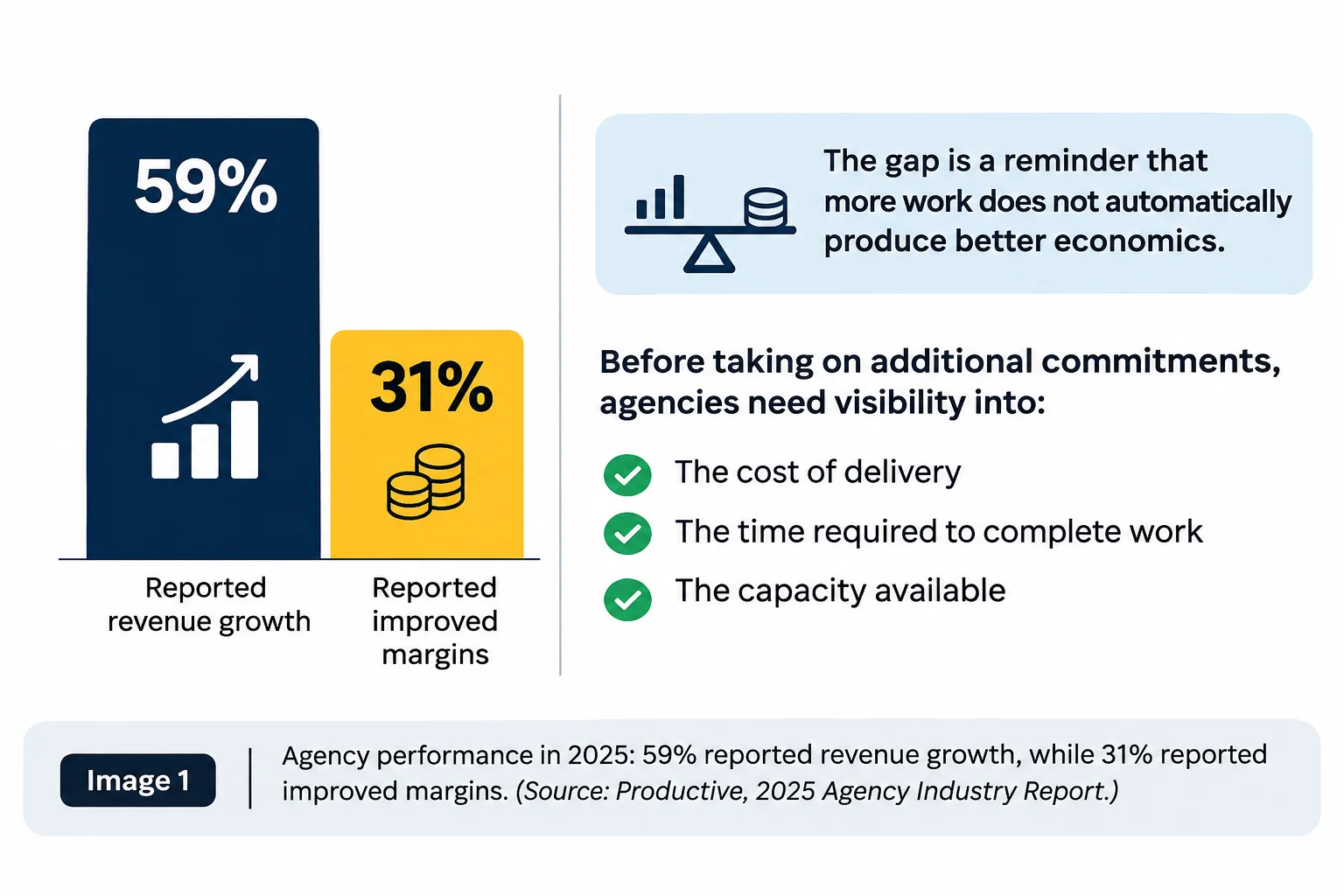
Revenue growth can also hide operational weaknesses. Productive’s 2025 Agency Industry Report of 93 leaders found 59% grew revenue but only 31% improved margins, showing more work doesn’t guarantee better economics. Agencies need clear visibility into delivery costs, time, and capacity before taking on more.
What Does Scaling an Agency Without Expanding Full-Time Staff Actually Mean?
It means increasing the amount of work the agency can deliver reliably without making every increase in demand dependent on a permanent hire. The agency retains a core team responsible for strategy, client leadership, creative direction and commercial decisions, then adds capacity through dedicated remote professionals, part-time support, specialist contractors, outsourcing or automation where appropriate.
Which Marketing Tasks Should an Agency Delegate First?
Agencies should delegate tasks that are repeatable, clearly defined, frequent enough to hand off, and easy to quality-check, while keeping ownership of work requiring deep business context, strategic judgment, confidential relationships, or final accountability. Delegation doesn’t remove responsibility: the agency lead sets the brief, reviews deliverables, and remains accountable to the client.
Start by listing all client-account activities, grouping them into strategic decisions, specialist execution, repeatable production, and administration, then evaluate each by frequency, complexity, risk, and senior time required. Allocation varies by service mix and client commitments.
|
Work area |
Tasks suitable for delegation |
Core team retains ownership of |
Possible support role |
|
Social media |
Scheduling approved posts, community monitoring, content uploads, calendar updates and basic performance summaries |
Channel strategy, brand voice, escalation decisions and client approvals |
Social media assistant |
|
Content marketing |
Research collation, briefs, formatting, CMS uploads, metadata, repurposing and editorial coordination |
Positioning, editorial standards, subject-matter accuracy and final approval |
Content marketing assistant |
|
SEO |
Keyword research support, technical checklists, on-page updates, link prospecting and reporting preparation |
SEO strategy, prioritization, interpretation and recommendations |
SEO assistant |
|
Paid media |
Campaign build support, naming conventions, pacing checks, creative trafficking and report preparation |
Budget authority, audience strategy, optimization decisions and client accountability |
Paid advertising specialist / campaign assistant |
|
Creative production |
Resizing, template adaptation, asset organization and production coordination |
Creative concept, art direction, brand integrity and final sign-off |
Graphic designer / creative production assistant |
|
Marketing operations |
CRM hygiene, data entry, lead routing checks, workflow QA and dashboard maintenance |
Data governance, lifecycle strategy, access policy and revenue attribution |
Marketing operations assistant |
|
Account operations |
Meeting notes, task updates, approval tracking, status reports and scheduling |
Client relationships, scope decisions, negotiation and escalation |
Virtual assistant / account coordinator |
Which Responsibilities Should Remain with the Agency’s Core Team?
Keep ownership of agency positioning, service design, pricing, client strategy, major creative decisions, budget approvals, sensitive client communication and final quality assurance with people who understand the business context and carry the relevant authority. These responsibilities may be supported by research or preparation from remote team members, but accountability should remain explicit.
Which Remote Roles Can Help a Marketing Agency Increase Capacity?
The right remote roles depend on where the agency loses time and which services are growing. Agencies do not need to recruit every role at once. They should identify the recurring workload that prevents the current team from delivering higher-value work, then select a role with a clearly defined scope and measurable outputs.
1. Social Media Assistant
A social media assistant manages the daily work that keeps brand channels organized, including content calendars, scheduling and publishing posts, platform-specific captions, coordinating assets, monitoring and escalating comments/messages, pre-post QA (links, tags, hashtags, formats), and basic performance reports. This supports overloaded teams, while strategists keep ownership of strategy, priorities, voice, campaigns, and sensitive replies.
2. Digital Marketing Assistant
A digital marketing assistant coordinates and executes campaigns across channels—building emails, updating web/landing pages, publishing blogs, managing assets, links, tracking parameters, calendars, leads, and reports. They work across email, CMS, ads, analytics, and CRM tools, centralizing tasks while managers set priorities, approve messaging, manage budgets, and interpret results.
3. SEO Assistant
An SEO assistant supports ongoing research, implementation, and monitoring for a search engine optimization program. Typical tasks include keyword and competitor research, updating title tags and meta descriptions, adding approved internal links, formatting/uploading content, checking indexing and broken links, monitoring rankings and traffic, and preparing technical SEO checklists. They can also organize content briefs and track SEO audit recommendations. The role works best with an agreed strategy and documented standards, while an SEO specialist/strategist handles diagnosis, prioritization, interpretation, strategy, and client recommendations.
4. Content Marketing Assistant
A content marketing assistant coordinates production to move content from idea to publication. Tasks include managing calendars, organizing research, creating briefs, coordinating writers/designers, formatting drafts, handling basic on-page checks, uploading to the CMS with images and links, repurposing for social/email, and tracking deadlines and approvals. Strategists/editors keep control of positioning, topics, standards, accuracy, tone, and final approval, especially for multi-client agencies and regulated, technical, or proprietary content.
5. Graphic Designer or Creative Production Assistant
A graphic designer or creative production assistant adapts visual assets within an established brand system and creative direction—resizing designs, updating templates, building social/presentation layouts, creating campaign variations, handling basic edits, exporting to spec, and organizing files. Senior designers may develop original concepts. Agencies should separate production from art direction, with the lead owning concepts, standards, and final approval through clear guidelines and processes.
6. Marketing Operations and CRM Assistant
A marketing operations and CRM assistant helps execute campaigns and manage leads by maintaining systems and data. Tasks include updating records, validating accuracy, managing fields/tags/lists, monitoring routing and automations, updating dashboards, reporting issues, documenting processes, and flagging broken integrations. The marketing ops lead to own architecture, integrations, governance, permissions, and journey/attribution changes.
7. Paid Advertising Support
A paid advertising assistant or campaign specialist executes paid media in Google Ads, Meta Ads, and LinkedIn Campaign Manager. They build campaigns from approved briefs, upload creatives, apply naming conventions, validate URLs/tracking, manage audiences, monitor pacing, report on optimizations, and flag anomalies. Senior specialists may handle research, testing, and limited optimizations, while the paid media lead owns strategy, budget, bidding, and client recommendations. Clear approvals and access limits help prevent costly errors.
Which Staffing Model Should a Marketing Agency Choose?
There is no single best staffing model for every agency. The right choice depends on how predictable the workload is, how much context the role requires, how long the work will continue, and how much day-to-day management is needed. Permanent employees may be appropriate for enduring leadership and core capabilities. Freelancers can suit defined specialist projects. Dedicated remote professionals can provide continuity for recurring operational work, while automation is useful for rule-based processes with stable inputs.
|
Model |
Best suited to |
Strengths |
Trade-offs to consider |
|
Full-time employee |
Permanent, high-context roles central to the agency’s offer |
Continuity, institutional knowledge, close collaboration and clear internal ownership |
Ongoing employment cost, recruitment time and less flexibility when workload changes |
|
Part-time remote professional |
Recurring work that does not justify a full-time workload |
Consistent support with a smaller time commitment |
Requires clear prioritization and realistic availability expectations |
|
Freelancer / specialist contractor |
Defined projects, short-term peaks or narrow specialist expertise |
Access to expertise without a long-term role commitment |
Availability can vary; context and knowledge may need to be rebuilt between projects |
|
Dedicated remote professional through a staffing partner |
Ongoing execution and operational support that needs continuity |
More consistent capacity and support with sourcing and placement |
Still requires onboarding, management, performance feedback and clear scope |
|
Outsourced agency / service provider |
A complete function or deliverable managed externally |
Can reduce internal coordination for a defined service |
Less direct control over daily work; scope, quality and communication must be explicit |
|
Automation / AI tools |
Stable, repetitive workflows with predictable rules and inputs |
Speed, consistency and reduced manual administration |
Needs monitoring, exception handling, data controls and human review |
How Can Remote Staffing Improve Agency Profitability?
Remote staffing can improve profitability when the value of the additional capacity and senior time released exceeds the full cost of the support arrangement. The relevant comparison is not simply an hourly rate versus salary. Agencies should include recruitment, onboarding, management, software, quality assurance, rework, and the effect on delivery speed. A low-cost resource that creates repeated corrections may be more expensive than a higher-skilled professional who completes work accurately.
|
Measure |
What to calculate |
Why it matters |
|
Cost per deliverable |
Total labor and operating cost for a defined output ÷ number of completed outputs |
Shows whether delivery becomes more economical |
|
Senior hours released |
Baseline senior hours spent on delegated tasks − senior hours still needed for oversight |
Tests whether delegation removes the actual bottleneck |
|
Rework rate |
Outputs requiring correction ÷ total outputs reviewed |
Reveals quality or briefing problems hidden by faster production |
|
On-time delivery |
Deliverables completed by agreed deadline ÷ total deliverables |
Measures reliability and client impact |
|
Capacity utilization |
Productive delivery hours used ÷ available delivery hours |
Shows whether capacity is available and being used sustainably |
|
Contribution margin |
Revenue attributable to the work − direct delivery costs |
Connects staffing choices to the economics of the service |
|
Client retention / satisfaction |
Renewals, feedback and service-level performance over time |
Checks that efficiency is not being achieved at the expense of client experience |
How Can an Agency Implement Remote Staffing Without Disrupting Client Delivery?
An agency should introduce remote staffing in stages: diagnose the workload, select a bounded role, document the work, recruit for the actual requirements, onboard the professional, run a controlled pilot and review performance before expanding the arrangement. Starting with one role or workflow makes it easier to identify problems and build a repeatable model.
Step 1: Audit the Work Before Recruiting
Review how the team spends its time over a representative period. List recurring tasks by client, service line, frequency, estimated hours, skill level, deadline sensitivity and consequences of error. Ask employees which activities interrupt their most valuable work. Compare planned hours with actual time where reliable tracking exists. The purpose is not to monitor people unnecessarily; it is to identify where capacity is being consumed and where work can be reorganized.
Step 2: Define a Role Around Outcomes
Avoid vague job descriptions such as “help with marketing”. Specify the tasks, platforms, expected outputs, quality standards, working hours, reporting line, and escalation rules. Define what the person can complete independently and what requires approval. For example, “prepare and upload five approved blog posts per week using the supplied checklist” is more actionable than “support content marketing”. Include examples of good work and a realistic workload.
Step 3: Document the Process
Create clear, step-by-step standard operating procedures (SOPs) for recurring tasks. Document the tools required, workflows, deadlines, approval stages, quality standards, and expected deliverables. This gives remote professionals a clear reference, reduces dependency on constant supervision, ensures consistency, and makes it easier to delegate work as your agency grows.
Step 4: Recruit for Capability and Communication
Evaluate candidates for role-specific skills, detail orientation, writing, problem-solving, and ability to follow documented processes using practical, job-relevant assessments—not just interviews or certificates. Also assess how they handle feedback and uncertainty. With shifting needs and gaps in digital, analytics, ROI, and compliance, assess technical skill and judgment per the American Marketing Association’s 2025 marketing skills research.
Step 5: Onboard with Access and Context
Introduce the professional to the agency’s service model, client context, brand standards, tools, communication norms, and quality expectations. Provide only the system access needed for the role, use individual accounts rather than shared passwords, enable multifactor authentication where available, and agree on how client data should be handled. A structured remote employee onboarding process helps establish expectations, build familiarity with the agency’s systems, and clarify progress during the first 30 days.
Step 6: Pilot, Review and Improve
Start with a small set of delegated tasks or one clearly defined role before expanding the arrangement across your agency. Monitor performance against agreed KPIs, assess the quality of deliverables, gather feedback from your team, and identify any workflow gaps. Use these insights to refine processes, adjust responsibilities, and improve communication. Once the model delivers consistent results, gradually expand the scope of delegated work.
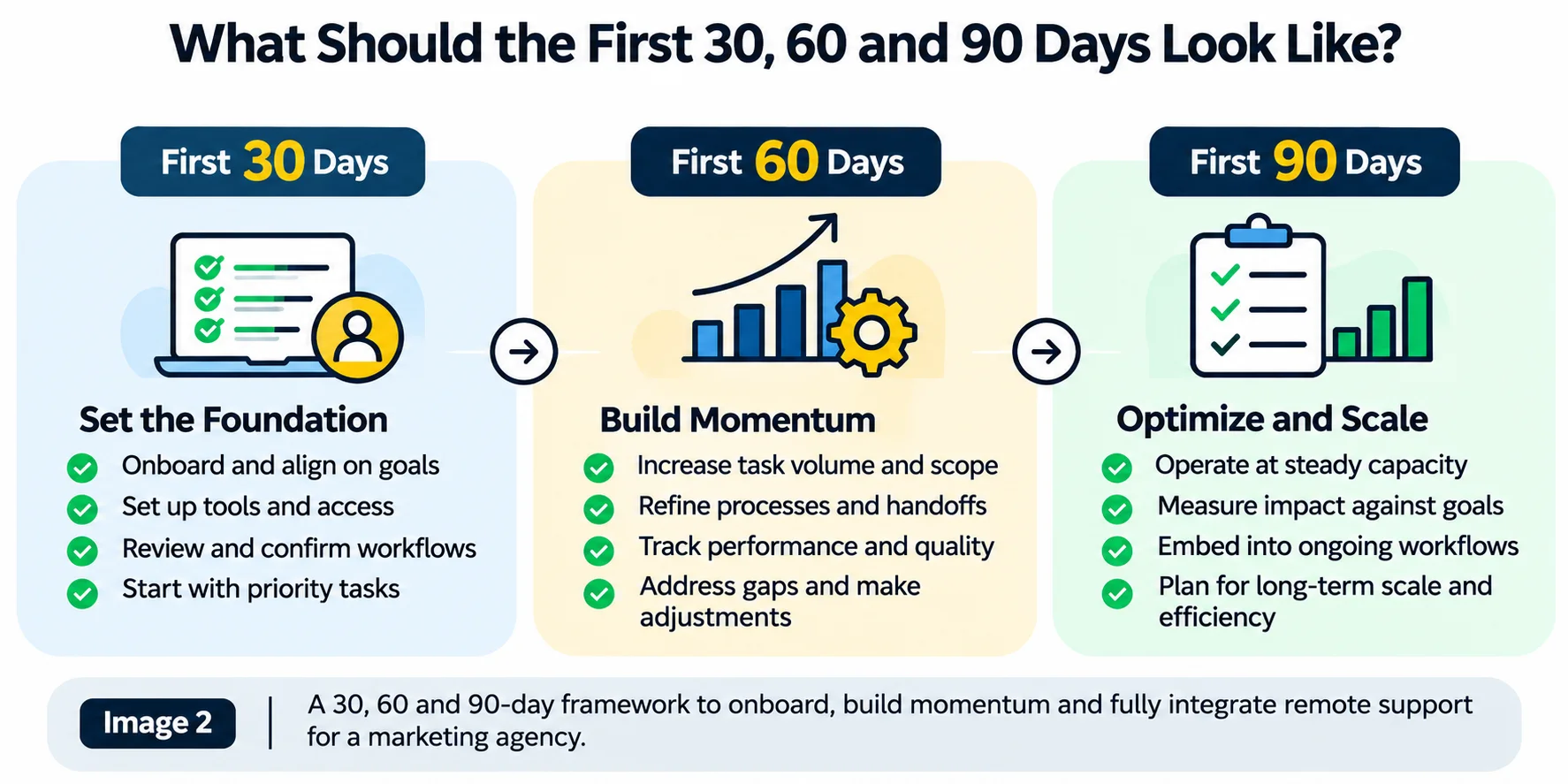
What Should the First 30, 60 and 90 Days Look Like?
|
Period |
Primary objective |
What good progress looks like |
|
Days 1–30: Learn and stabilize |
Understand the agency, tools, clients, SOPs and quality standards |
Completes lower-risk tasks with guidance; communicates blockers early; follows security and approval rules |
|
Days 31–60: Build consistency |
Increase ownership of agreed recurring tasks |
Meets quality and deadline expectations more consistently; needs less routine clarification; flags process gaps |
|
Days 61–90: Improve performance |
Evaluate capacity, quality and workflow improvements |
Owns the agreed workflow within defined limits; contributes process improvements; performance is reviewed against agreed measures |
The timeline is a management framework, not a guarantee that every role will reach the same level of independence in 90 days. Complex accounts, specialist tools, and regulated client environments may require longer. Managers should set expectations based on the actual work and the professional’s starting capability.
How Should Agencies Manage Remote Professionals and Protect Quality?
Remote teams thrive when agencies set clear rules for how work moves: who assign tasks, approves deliverables, escalates urgent issues, documents decisions, and reviews performance. Without this structure, remote staffing can increase messaging and management instead of capacity.
Use one project management system as the single source of truth for tasks, owners, deadlines, and status, and keep briefs and feedback in each task. Maintain a consistent check-in cadence and evaluate performance by output quality and timeliness—not online presence.
What Are the Most Common Mistakes Agencies Make When Scaling with Remote Support?
- Delegating without defining the outcome. A task description that lacks examples, deadlines and quality criteria creates avoidable rework.
- Hiring before identifying the bottleneck. Agencies may recruit a general assistant when the real constraint is specialist review; poor client approvals or scope creep.
- Expecting a remote professional to operate without management. Delegation transfers execution, not the agency’s responsibility to set priorities and provide feedback.
- Giving broad system access too early. Access should be role-based, limited and reviewed as responsibilities change.
- Measuring activity instead of results. Online status and message volume do not prove that work is accurate, timely, or useful.
- Scaling the model before the pilot works. Expanding an unclear process multiplies between confusion and quality problems.
- Ignoring workload and utilization. A support professional can be underused while senior employees remain overloaded if work allocation is not reviewed.
A related issue is treating remote support to accept unlimited client work. Capacity must still be planned. Every new account needs onboarding time, communication, approvals, and contingency. Agencies should model realistic workloads and preserve a buffer for urgent requests, leave, and unexpected complexity.
How Do AI and Automation Fit into a Scalable Agency Workforce?
AI and automation should remove repetitive friction and support human work, not become a substitute for accountability. Agencies can automate report data collection, task reminders, lead routing, file organization, status notifications and repeatable content operations when the workflow is stable, and the risks are understood. AI can assist with research synthesis, first drafts, tagging, summarization and analysis, but outputs need human review for accuracy, originality, brand fit and compliance.
The Agency Analytics 2026 report found that 79% of surveyed agencies save at least five hours per week using AI, with reporting and performance summaries cited as the leading area of value. The report also found that 38% were already using agentic AI for workflow automation. These findings suggest that automation is becoming part of agency operations, but they do not mean every task should be automated or that every agency will achieve the same time savings. The AgencyAnalytics 2026 research provides the survey context behind these figures.
How Can Agencies Build a Scalable Workforce Model?
A practical workforce model has three layers: a core team that owns direction, relationships, standards, and commercial decisions; a flexible delivery layer that manages recurring production and operations via dedicated remote professionals or part-time support; and a specialist layer for project-based expertise. Automation strengthens all three by reducing coordination and improving visibility.
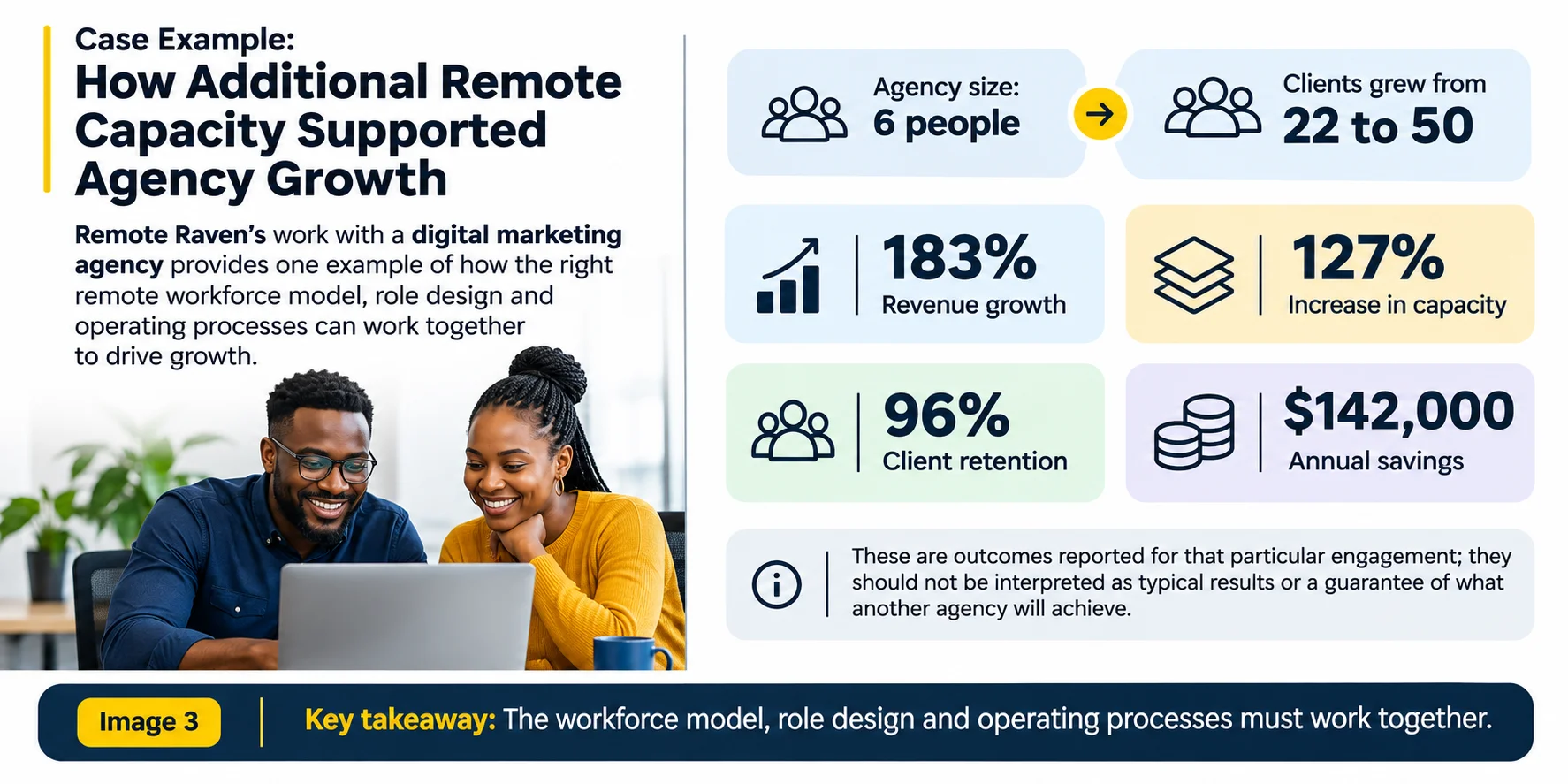
Remote Raven’s work with a digital marketing agency illustrates the impact of added remote capacity: a six-person agency grew from 22 to 50 clients, reporting 183% revenue growth, 127% more capacity, 96% retention, and $142,000 annual savings—results specific to that engagement. The key takeaway is aligning workforce model, role design, and processes.
When Should a Marketing Agency Consider Remote Staffing?
Remote staffing may be worth considering when the agency has recurring work that is delaying delivery, senior specialists are spending too much time on administrative or production tasks, new business is being declined because of capacity, or workload fluctuates too much to justify another permanent position. It can also help when the agency needs a skill that is difficult or expensive to recruit locally, provided the work can be managed effectively across locations.
How Can Remote Raven Help Marketing Agencies Scale?
Remote Raven helps businesses—and especially marketing agencies—build remote staffing capacity around the work that needs to get done.
Agencies can add dedicated remote professionals for recurring execution tasks such as social media delivery, digital marketing coordination, SEO implementation, creative production, paid campaign operations, and CRM administration. The process starts by mapping your workflow, defining responsibilities, outcomes, collaboration expectations, and required experience, then identifying a professional who can integrate with your team while you retain control of strategy, client relationships, and quality. You can review candidates, plan onboarding, and set performance measures.
Book a free 30-minute consultation with Remote Raven
Frequently Asked Questions
Can a Marketing Agency Grow Without Hiring Full-Time Employees?
An agency can expand delivery capacity with dedicated remote professionals, part-time support, specialist contractors, outsourcing, and automation. Keep strategy, client relationships, quality, and commercial decisions in-house, with clear scopes and measurable performance.
What Is the Best First Remote Role for a Marketing Agency?
Choose the first role that eliminates the agency’s biggest measurable bottleneck. Common options include a social media assistant, digital marketing assistant, SEO assistant, creative production assistant, or marketing ops assistant. Audit workload first.
Is Remote Staffing Cheaper Than Hiring a Full-Time Employee?
It can reduce fixed staffing commitments or provide access to capacity at a different cost, but the comparison must include management, onboarding, software, quality assurance, rework, and continuity. The cheapest hourly rate is not necessarily the lowest total cost.
What Tasks Should Marketing Agencies Not Outsource?
Agencies should maintain ownership of strategy, client relationships, pricing, key creative decisions, approvals, and accountability. Research and execution can be delegated, but authority and responsibility must stay clear.
How Do You Maintain Quality When Working with Remote Marketing Professionals?
Use documented processes with clear briefs, examples, approvals, role-based access, predictable communication, and measurable standards. Review by risk, give timely feedback, and don’t rely on online presence to measure performance.
How Many Remote Professionals Does an Agency Need?
There is no universal number. Start with the recurring workload, the hours or deliverables requiring support and the level of oversight available. One well-scoped role may remove a bottleneck; a larger agency may need several specialists.
Can Remote Professionals Work Directly with Agency Clients?
Yes, when the agency has defined the role, communication rules, and approval authority. The agency should retain ownership of the client relationship and all material commitments.
How Long Does It Take to Onboard a Remote Marketing Assistant?
Onboarding time depends on role complexity, systems, client context, and documentation quality. A 30-60-90-day plan can establish expectations and review progress, but readiness is not guaranteed by a fixed timeline.
Can AI Replace Remote Marketing Assistants?
AI can accelerate some tasks, but people are still needed to manage workflows, verify outputs, apply context, handle exceptions, and take responsibility. The strongest model combines automation with skilled human oversight.
How Should an Agency Measure Whether Remote Staffing Is Working?
Track delivery time, on-time completion, rework, senior hours released, utilization, cost per deliverable, margin, and client satisfaction. Benchmark performance and confirm released capacity is used productively.
Conclusion: Scale Capacity Before Adding Permanent Complexity
Marketing agencies don’t need to choose between turning away new business or endlessly growing full-time teams. By identifying time drains, reserving senior judgment for high-value work, and assigning repeatable execution to the right people and systems, they can expand capacity. At Remote Raven, we believe sustainable agency growth comes from an operating model that scales without requiring a permanent hire for every new client.